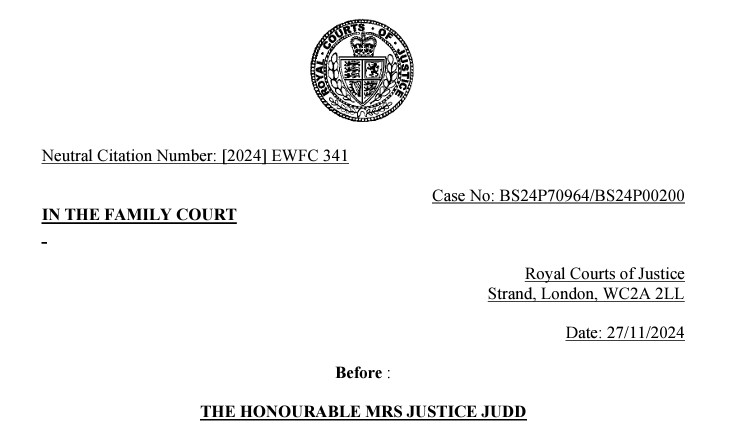
In a reported judgment this week, the court was required to consider the interpretation and application of s 54(7) Human Fertilisation and Embryology Act (HFE Act) 2008, in the most tragic of circumstances.
Following a difficult pregnancy, the surrogate suffered respiratory arrest during the caesarean section owing to a reaction to anaesthesia. This left her with hypoxic brain injury and cognitive impairment. As such, it was necessary for Judd J to consider whether the surrogate was capable of providing her consent to the parental order.
The consent requirement
S 54(6) HFE Act states that, for a parental order to be granted, the surrogate must provide her free and unconditional consent to the order. Unlike adoption orders, in which the birth mother’s consent can be dispensed with based on the child’s lifelong welfare, it is not possible for a parental order to be granted absent the consent of the surrogate. However, the consent requirement is subject to s 54(7), which states:
Subsection (6) does not require the agreement of a person who cannot be found or is incapable of giving agreement; and the agreement of the woman who carried the child is ineffective for the purpose of that subsection if given by her less than six weeks after the child’s birth.
The issue for the court in the present case, therefore, was whether it could be said that the surrogate was ‘incapable of giving agreement’. Judd J stated that whether an individual was incapable of giving consent was a question of fact for the court. It was deemed to be wider than the capacity determination under the Mental Capacity Act (MCA) 2005, which is the required standard under the Adoption and Children Act (ACA) 2002. A significant difference between the HFE Act in relation to parental orders and the ACA in relation to adoption orders, is that the ACA frames the ability to consent in terms of capacity, with reference to the MCA, whilst the HFE Act refers to the individual as being ‘incapable’ of consenting. The table below details the different articulations of capacity (or lack thereof) in the statutes:
| HFE Act 2008 | ACA 2002 | MCA 2005 |
| S 54(7): …does not require the agreement of a person who cannot be found or is incapable of giving agreement. | S 52(1): the court cannot dispense with the consent of any parent or guardian of a child to the child being placed for adoption or to the making of an adoption order in respect of the child unless the court is satisfied that – (a) the parent or guardian cannot be found or lacks capacity (within the meaning of the Mental Capacity Act 2005) to give consent, or (b) the welfare of the child requires the consent to be dispensed with | S 2(1): a person lacks capacity in relation to a matter if at the material time he is unable to make a decision for himself in relation to the matter because of an impairment of, or a disturbance in the functioning of, the mind or brain. S 3(1): a person is unable to make a decision for himself if he is unable— (a) to understand the information relevant to the decision, (b) to retain that information, (c) to use or weigh that information as part of the process of making the decision, or (d) to communicate his decision |
As such, Judd J stated that the provisions of the MCA are likely to be relevant to a determination under s 54(7), but potentially wider:
The court is likely to wish to consider the person’s ability to understand the information relevant to the decision, to retain it, to use and weigh it, and to communicate it, but may take into account other issues too. [para 29]
The decision
Judd J was satisfied that a further report as to the surrogate’s capacity was not necessary, because the evidence provided to the court clearly demonstrated that she was unable to meet the standard required under s 54(6). Whilst it was acknowledged that her ability to consent could change in the future, the ‘extent and timing of that is unknown’ [31].
Notwithstanding the fact that the surrogate was incapable of providing her consent, the judgment did refer to several significant factors that supported the granting of the parental order.
First, the child’s Guardian reported that, upon speaking to the surrogate’s partner, he expressed certainty that she would have agreed to the parental order had she been able. She had been a surrogate on several occasions in the past, and derived satisfaction from the altruism of helping others to become parents.
Further, in conversations that the surrogate had with the Official Solicitor, she repeatedly expressed her concerns that she would be asked to take the baby back, and was able to articulate the intention that the baby would be the intended parent’s straight away.
As such, in her concluding comments, Judd J stated:
It is quite clear from all the evidence before me that [the surrogate] has long been motivated to help others to have a baby they cannot carry themselves. There is no doubt that this is what she was doing when she so tragically suffered an allergic reaction to the anaesthetic she was given for the caesarean section. [34].
Therefore, even though the requirement for the surrogate’s consent was dispensed with, on the basis that such consent could not be given, the judgment indicates that had she been able to, she would have agreed to the order being made.
As with all parental order cases, the ultimate consideration as to whether to grant the order was the child’s lifelong welfare. On the facts of the case, the child was thriving in the intended parent’s care and described as a ‘much wanted and loved child’. As such, the parental order was made.
This is the first reported decision where s 54(7) has been applied owing to the surrogate being incapable of giving consent, although there has been greater judicial scrutiny of the provision as regards the surrogate not being able to be located. The case demonstrates the importance of the ability to dispense with consent in defined circumstances, in order to ensure that the intentions of the parties are met and, most significantly, that the welfare of the child is satisfied.

 reforming surrogacy law
Leave a reply to Case Update: Anonymous surrogacy and consent (Re H (Anonymous Surrogacy)) – reforming surrogacy law Cancel reply