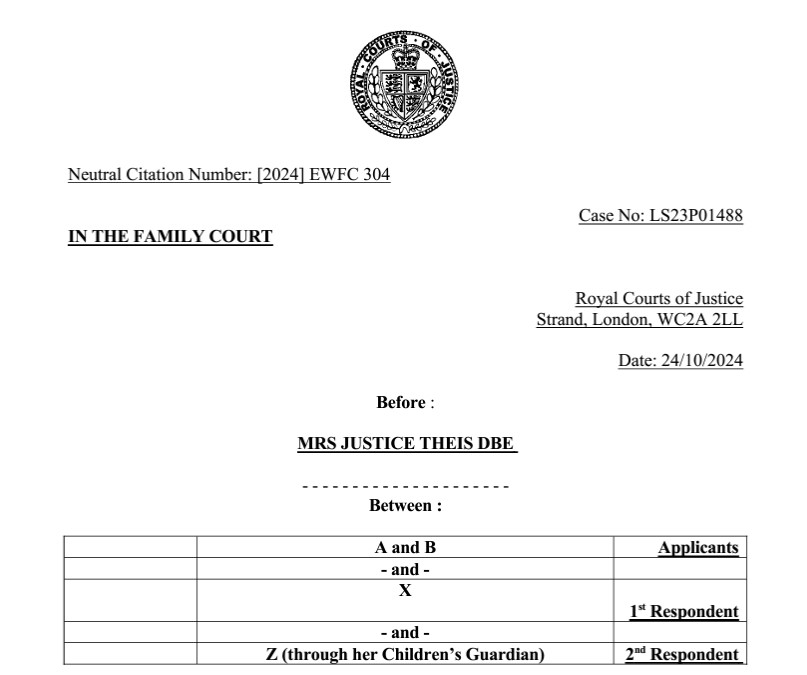
The case of Re Z (Foreign Surrogacy), heard by Theis J in October provides an interesting insight into how factors beyond s54 Human Fertilisation and Embryology Act 2008 may become relevant when determining whether to grant a parental order following a surrogacy arrangement. As has been discussed in several posts on this blog, whilst the s54 criteria must be satisfied for a parental order to be granted, the court must also be satisfied as to the lifelong welfare of the child. It was not these two legislative frameworks, however, that were the primary focus of the judgment. Instead, the case elucidates the challenges of cross-border surrogacy arrangements and the impact that public policy may have on the decision as to whether to grant a parental order.
Theis J’s opening paragraph to the judgment set the tone for the case, stating how the case acts as:
an important cautionary reminder of the need for those embarking on surrogacy arrangements, particularly those that cross a number of different jurisdictions, to carefully consider, in advance, the arrangements, consequences and implications of that arrangement. [para 1]
Background
The background to this case is complex and spans multiple jurisdictions. The intended parents, a same sex male couple, met in the UK and have been in a civil partnership since 2018. Both men were born in countries that are not tolerant of same-sex relationships, and both attested to the fact that they had no intention to return to their countries of birth, having leave to remain in the UK.
After deciding that they wanted to start a family, the intended parents engaged with a foreign surrogacy agency. Despite the agency being based in a country that does not permit surrogacy for same-sex couples, the intended parents were assured that all procedures would take place in Cyprus. The intended parents opted for the ‘premium package’ (at 64,000 EUR) which ‘guaranteed’ they would become parents. They were advised that only one intended parent should sign the agreement, to ‘avoid any issues’. This, arguably, was one of the first flags as to the nature of the agency and agreement that was being entered into.
An anonymous egg donor travelled to Cyprus from another country for the egg collection, and the gametes of one of the intended parents was used to create the embryos. The surrogate was then introduced by the agency – she lived in the country where the agency was based and had been a surrogate before. After signing the contract, the surrogate travelled to Cyprus for the embryo transfer and then returned home.
Once the pregnancy was confirmed, the intended parents started to get advice on obtaining a parental order. When speaking to the agency about the matter, they were advised to not inform the embassy about the same-sex relationship or surrogacy birth. The agency then advised that it would be preferable for the birth to take place in a country other than Cyprus (and nor in the country where the agency was based), given that it would be easier for the child to obtain a passport. The country that the birth took place in did not permit surrogacy for same-sex couples.
After the birth of the child, the genetic intended parent and surrogate jointly registered the birth, and the surrogate granted sole responsibility for the child to the intended parent. It was only after the birth of the child that the surrogate became aware that the intended parent was in a same-sex relationship. Despite this, she continued to be supportive of them obtaining parenthood. Upon return to the UK, the intended parents sought a parental order to remove the surrogate’s status as the legal mother and to recognise both intended parents as the child’s legal parents.
The decision: s54 criteria
Theis J granted the parental order in this case, satisfied that the s54 criteria had been met. The criteria themselves were not the primary concern of the case. Nonetheless, there were some criteria that warranted further consideration, as follows:
- Time limit – the parental order must be sought within 6 months of the child’s birth: not withstanding this statutory criteria, there is a wealth of case law in which the time limit had been exceeded and a parental order still granted, on the basis of the child’s welfare. In this case, the application was made only just outside of the time limit, and Theis J was of the opinion that ‘no sensible result would be achieved’ to prevent the parental order on this basis.
- Domicile – it must be proven that at least one of the intended parents is domiciled in the UK: given that both intended parents were born in another jurisdiction, it needed to be established that the UK had become a domicile of choice. Based on the intended parent’s conduct, commitment to the UK, and definite intention to not return to their country of birth, the court was satisfied that a domicile of choice had been established in UK for the genetic intended parents.
- Consent – the surrogate must freely and unconditionally consent to the parental order: in this case, even though the prescribed form was not used to document the surrogate’s consent, all the evidence demonstrated that she had freely and with full understanding consented to the parental order in favour of both intended parents. The fact that she was not aware of the same-sex relationship until after the child’s birth did not impact upon her consent because her wishes remained the same after this became apparent.
- Payments – payments beyond reasonable expenses cannot have been paid to the surrogate, unless authorised by the court: within the ‘premium package’ paid, the compensation element for the surrogate was 20,000 EUR. In deciding whether to authorise payments beyond reasonable expenses, the court has established a test that such payments should be approved unless it would be contrary to public policy. The issue relating to public policy is examined in more detail in the section below, but ultimately, Theis J was satisfied that any payment made to the surrogate beyond expenses reasonably incurred could be authorised.
Public policy and lessons from the judgment
When deciding whether to authorise payments beyond reasonable expenses, a key consideration for the court is public policy. This, it is apparent from the judgment, is the aspect of the arrangement that Theis J found most troubling in the present case. The intended parents entered into a surrogacy arrangement in a jurisdiction that they knew did not permit same-sex surrogacy, and actively concealed the nature of their relationship both at the point of signing the agreement and when registering the birth of the child. Nonetheless, it was argued by the counsel representing the applicants and the child that the intended parents had acted in good faith in relying on the advice given to them by the agency. Theis J, ‘not without some hesitation’ accepted this submission, although took the view that ‘the behaviour of the applicants is to be deprecated, they turned a blind eye to what should have been obvious to them and took risks, seeking to lay the responsibility at the agency’s door’ [para 54].
To refuse to grant a parental order based on public policy would have adversely affected the child’s lifelong welfare, resulting from uncertainty as to her legal status. Therefore, the court authorised the payments and the parental order was made.
As with many parental order cases, regardless of the circumstances leading up to and following the birth, when the surrogate-born child is in the care of the intended parents, it is unlikely that a parental order will be refused. However, the judgment makes clear that intended parents must consider the consequences of their decisions and the impact they may have on the child, before they embark on a surrogacy journey. Theis J stated that the intended parents had undertaken ‘risks to pursue their own wish to have a child rather than confront the harsh reality of what they were doing and the consequences of those actions’ [para 51].
The case therefore provided an opportunity to lay out what intended parents should consider before entering into a surrogacy arrangement. The judgment laid out 16 questions, submitted by counsel and amended by Theis J, as to what should be asked before embarking on the surrogacy arrangement. The questions fell into the following broad categories:
- Legal framework for surrogacy in the country where the arrangement will take place
- Legal parenthood (of all potential parties, including surrogate, spouse and intended parents)
- The role of the agency, and the support and interactions for and between the surrogate and intended parents
- The expectations in relation to the ongoing relationship between the surrogate and child
- The child’s nationality and immigration status
- The availability of information to provide for the parental order and to the child
Conclusion
Ultimately, the case had the desired outcome: the intended parents have secured their legal relationship with the child, and they are functioning as a family unit, with a good relationship with the surrogate. However, the facts of the case demonstrate how issues could have arisen at several points during the arrangement, from signing the initial agreement through to the surrogate becoming aware of the intended parents’ relationship. Cross-border surrogacy poses unique challenges, particularly when there are multiple jurisdictions – with differing regulation – involved. The guidance given in this judgment should prove useful for intended parents when making decisions relating to their surrogacy journey.

 reforming surrogacy law
Leave a reply to Renewed warnings of the risk of international surrogacy arrangements: X v W & Another and Re Z (Unlawful Foreign Surrogacy: Adoption) – reforming surrogacy law Cancel reply