Trigger warning: stillbirth and infant loss, birth trauma, death.
Any pregnancy typically carries with it the expectation of a safe arrival and birth of a healthy baby. However, it is important to acknowledge the possibility of an unforeseen and tragic outcome such as the loss of the baby, death of the surrogate, or even one or both intended parents.
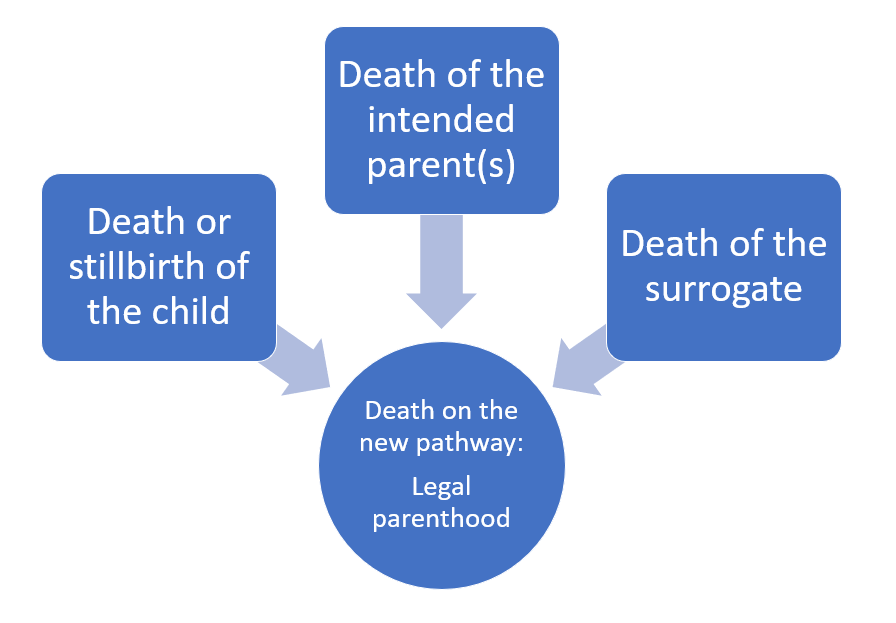
Recognising the potential for such outcomes, the Law Commissions considered the circumstances the parties may be left in if the worst-case scenario materialises. Within the Consultation Paper, they highlighted concerns expressed by intended parents who feared that their child may be left in ‘legal limbo’ due to the ambiguity of the current law, especially regarding legal parenthood. The Law Commissions have attempted to address these concerns within their Final Report, explicitly making provision for legal parenthood and registration if a tragic incident occurs. This post will consider the recommendations made by the Law Commissions in three circumstances: death or still birth of the surrogate-born child, death of the surrogate and death of intended parent(s).
Stillbirth or death of the surrogate-born child
The Law Commissions addressed this issue in two-parts:
- The stillbirth of the child;
- Where the child dies post-birth, but prior to a parental order being made.
Legally, ‘stillbirth’ or a ‘stillborn child’ is defined as…
‘a child who has issued forth from its mother after the 24th week of pregnancy and which did not at any time after being completely expelled from its mother, breathe or show any other signs of life…’
In England and Wales, Births and Deaths Registration Act 1953 s 41 as amended by the Still-Birth Definition Act 1992, s 1(1); in Scotland, Registration of Births, Deaths and Marriages (Scotland) Act 1965 s 53(1) as amended by the Still-Birth (Definition) Act 1992 s1(2).
Stillborn births require a formal documentation process, where the legal parents must be recorded on the stillbirth register, and on a Certificate of Stillbirth. Further, in Scotland this also gives rise to the legal parent(s) having control over the burial or cremation of that child.
Under the current law, as the surrogate acquires automatic legal parenthood over the child, and the intended parents do not obtain legal parenthood until a parental order is granted, the surrogate will be documented as the legal parent of the child on the Certificate of Stillbirth.
For sensitive issues such as the death of the child, it is important that the law reflects the relationship that both the surrogate and the intended parents have with that child. It can be difficult to balance between the surrogate, who has had the experience of carrying the child for the duration of the pregnancy, and the intended parents, who would have an emotional attachment for the child that was expected to be in their care. As such, it can be difficult to determine whose legal parenthood should be prioritised.
The Law Commissions response:
In the initial Consultation Paper, the Law Commissions provisionally proposed that the intended parents be recognised as the legal parents of the stillborn child, allowing them to register the stillbirth, subject to the surrogate’s right to withdraw consent. However, this position changed in the Final Report, on the basis that this proposal was not sufficiently reflective of the surrogate’s relationship with the child, regardless of the safeguard of the surrogate’s right to withdraw consent.
Instead, the final recommendations are based on guidance produced by the Human Tissue Authority (HTA), which states that decisions concerning a stillborn child should be taken by the person who has given birth (thus being the surrogate).
Therefore, based on guidance produced by the HTA, the Law Commissions’ final recommendation is that in all cases:
- The surrogate will be the legal parent of the stillborn child, and in all circumstances the only person able to consent to a post-mortem examination of the child; but
- The surrogate can consent to the intended parents being the legal parents of the stillborn child, enabling them to register the stillbirth.
Death of the child prior to a parental order being made
In circumstances where a child dies prior to the parental order being granted, the current legal framework means that the surrogate (and her spouse, if applicable) would be the child’s legal parents.
For cases on the new pathway, the intended parents would be the legal parents from birth, unless the child died within 6 weeks of the birth and the surrogate exercised her right to withdraw consent.
However, for cases that fall outside of the new pathway, the surrogate would still be the legal parent until a parental order is granted. There could, therefore, be situations where the child dies before the intended parents can establish legal parenthood.
The Law Commissions response:
In the Consultation Paper, it was provisionally proposed that in such circumstances the surrogate should be able to consent to the intended parents being registered as the legal parents, provided that the intended parents, at the point of registering the birth, make a declaration that the parental order criteria would have been met.
Despite agreement with these proposals from consultees, the Law Commissions changed their approach to this issue in the Final Report due to concerns over the fact that the proposals would effectively allow the surrogate to transfer legal parenthood without any legal oversight.
Instead, the final recommendations make provision that where the case falls off the new pathway, a post-mortem parental order must be applied for. This could arise in three circumstances: where the arrangement was never proceeding on the new pathway, the surrogate withdrew her consent pre-birth, or the surrogate withdrew her consent within the 6-week time frame post birth. In the former two circumstances, the intended parents would be applying for the parental order, and in the latter situation, it would be the surrogate applying for the parental order.
The post-mortem parental order application process would be largely the same as the usual parental order process, with two important differences:
- The court would not be able to dispense with the requirement for the surrogate (or the intended parents) to consent to the granting of the parental order; and
- The court would be compelled to grant a parental order if the relevant criteria were satisfied. As the child would be deceased, the best interest standard could not be applied.
Arguably, these recommendations reflect a more nuanced and specific approach compared to the initial proposal in the Consultation Paper, more closely aligning with the other recommendations. The requirement for a post-mortem parental order adds a burden to parties at a very difficult time, but better reflects the approach to legal parenthood seen across the recommendations.
Death of the surrogate
If the surrogate were to die following a surrogacy arrangement, the implications in terms of the arrangement and legal parenthood would depend upon whether the case were on the new pathway, and at what point the death occurred.
Within the Consultation Paper, the Law Commissions sought views on whether consultees believed that if the surrogate died prior to the end of the 6-week period to withdraw consent on the new pathway, whether the surrogacy arrangement should exit the new pathway. This would then necessitate the intended parents to obtain a parental order.
However, this gained limited support. This is likely due to the uncertainty of the recommendation, whereby an unfair burden is placed on the intended parents (through being taken off the new pathway) based on an assumption that the surrogate may withdraw consent which may never have materialised.
The Law Commissions response:
Therefore, instead, in the Final Report it was recommended that the agreement should remain on the new pathway even in the event of the surrogate’s death, unless she had previously withdrawn consent within the six-week period. As such, the final recommendations are as follows:
- Where the case was not on the new pathway: the intended parents can continue to apply for a parental order, and it would not be a requirement for the surrogate to have consented to the granting of the parental order.
- Where the surrogate had not withdrawn consent before death on the new pathway: the intended parents will be recognised as the child’s legal parents.
- Where the surrogate had withdrawn her consent prior to birth of the child: the surrogate will be the legal mother and the intended parents can apply for a parental order.
- Where the surrogate had withdrawn consent within six weeks following the birth of the child: the intended parents will be the child’s legal parents, but the surrogate’s representatives can make, or continue, an application for a parental order in the surrogate’s favour.
The Law Commissions proposed, in priority order or who may make an order on their behalf:
- A person named by the surrogate as the guardian of the child;
- A person in a close relationship with the surrogate; or
- The relatives or a longstanding friend of the surrogate.
Death of the Intended Parent(s)
The existing law has had to deal with how legal parenthood should be attributed following the death of an intended parent, and the court have granted parental orders to deceased intended parents.
The effect of the death of an (or both) intended parents could depend upon when the death occurred and whether the arrangement was on the new pathway. The ability for a deceased intended parent to be recognised as the legal parent of the child can have significant implications – both in practical practical (which will be addressed in a later post) and in recognising the important and formative role that intended parent played in the conception (and therefore reality) for the child.
The Law Commissions response:
The final recommendations break down how the legal framework should operate in various circumstances where an intended parent dies, summarised below:
- When both intended parents die and the arrangement is outside the new pathway: the Law Commissions recommend the same ‘priority list’ as seen above, allowing a representative to apply for a parental order in favour of the deceased intended parents. As with all parental order cases, the best interests of the child will be paramount.
- When both intended parents (or a sole intended parent) on the new pathway dies (and the surrogate has not withdrawn consent): the deceased intended parents will be the legal parents.
- Where there are two intended parents on the new pathway and one dies, either before or after the child is born: the Law Commissions recommend that the intended parents still become legal parents of the child (subject to the surrogate having the right to withdraw her consent within the six-week period).
- Where an intended parent on the new pathway dies before the assisted reproduction procedure takes place: the Law Commissions recommend that the surviving intended parent becomes the child’s legal parent from the moment of birth. The surviving intended parent could apply for a legal order so that the deceased intended parent is officially named on the child’s birth certificate (on the basis of a genetic link between the deceased intended parent and the child).
- Where there are two intended parents, on an arrangement outside the new pathway, and one dies: the surviving intended parent can make an application for a parental order on behalf of both parents, as is currently the case.
Conclusion
In conclusion, the Law Commissions’ Final Report addresses the complexities of legal parenthood in various tragic scenarios. Their recommendations aim to strike a fair balance between the parties by recognising the surrogate’s role in the birth of the child in cases of stillbirth or the death of a child whilst still recognising the formative role of the intended parents in providing the ability to apply for post-mortem parental orders depending on the circumstances.
If the surrogate dies, the Final Report recommends keeping the surrogacy agreement on the new pathway unless she had previously withdrawn consent which offers security to intended parents. Further, when an intended parent dies, the surviving intended parent may become the child’s legal parent, and steps have been suggested to include the deceased intended parent on the birth certificate. As a result, these reforms clearly aim to provide clarity, respect parties’ intentions, and address concerns, while protecting the best interests of all parties involved in the arrangement in the most difficult of circumstances.

 reforming surrogacy law
Leave a reply to When the worst happens: death on the new pathway (inheritance and beyond) – reforming surrogacy law Cancel reply