Ensuring that a surrogate-born individual has the ability to access information relating to their origins, including the nature of their birth and both genetic and gestational parents, is an emerging issue. It is now more widely recognised that a surrogate-born child has not only a vital interest in knowing this information, but a substantive legal right owing to them to access such. The United Nations Convention on the Rights of the Child contains two specific rights pertaining to this: Article 7, the right to know their parents (which can be understood to include social, genetic and gestational parents) and Article 8, the right to preserve their identity (with birth information being a formative part of an individual’s identity).
The recommendations made by the Law Commissions in the Final Report relating to a surrogate-born individuals’ ability to access information includes both amendments to existing rules relating to access of relevant information and the introduction of a new Surrogacy Register.
The new Surrogacy Register
The Surrogacy Register, which would be maintained by the Human Fertilisation and Embryology Authority (HFEA), would allow surrogate-born individuals to access – in one place – information relating to all parties involved in the surrogacy arrangement.
The Law Commissions recommended:
The Surrogacy Register will record information for all surrogacy agreements, whether in or outside the new pathway, domestic or international, and gestational or traditional. This will mean that more surrogate-born people can access the information about their origins using it.
Core Report, page 70.
As such, information will be provided on the Surrogacy Register for cases that progress on the new pathway, as well as those that follow the parental order process.
In terms of what information the Surrogacy Register will contain, it is recommended that the following details are held:
- The name and details of the surrogate, making clear if she is also a genetic parent.
- The name and details of the intended parent(s), regardless of whether they subsequently became the legal parents, making clear if they are also genetic parents.
- The name and details of any former intended parent who subsequently withdrew from the arrangement, making clear if they are also a genetic parent.
- The name and details of any gamete donor. Where the donor’s identity is recorded on the HFEA Register of donor conception, the Surrogacy Register will refer to the HFEA Register. Where a donor’s identity is not known, this should be noted on the Surrogacy Register, with as much information as possible provided.
- The name and details of the Regulated Surrogacy Organisation for cases on the new pathway.
- Non-identifying information relating to the surrogate, intended parents or donors, which may include things such as physical descriptions, ethnic group and marital status.
Age of access
The closest analogous framework to the proposed Surrogacy Register is the HFEA Register for donor conception. This Register is available to individuals to access non-identifying information upon reaching the age of 16, and to access identifying information relating to the donor at the age of 18 (where the gametes were donated after 1 April 2005). Despite it being potentially easier to align the Surrogacy Register with the HFEA Register, the Law Commissions have recommended a different scheme in relation to age of access, recognising that individuals below these ages may have a legitimate interest in accessing the information. The rules differ between England and Wales and Scotland, owing to different legal tests of capacity across the two jurisdictions. The figure below details the age for access:
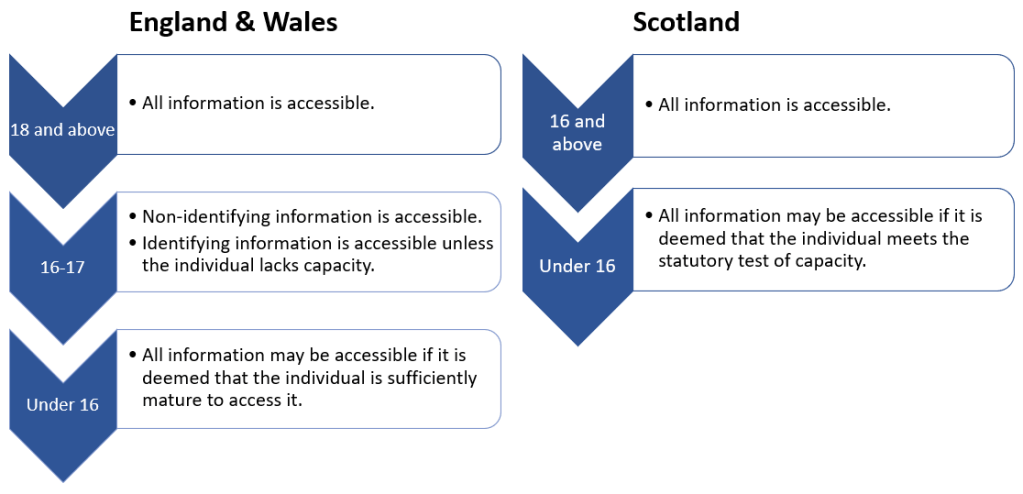
At any age, the recommendations include an offer of counselling prior to accessing the information on the Register.
Knowledge of arrangement
The Surrogacy Register would be a big step forward in creating a centralised point of access for individuals to obtain information relating to their birth and origins. However, the Surrogacy Register would only be accessed by individuals who are aware of the fact that they were born through surrogacy. Similar issues have arisen in the adoption and donor conception context, whereby information is available but not accessed as a result of the individuals not knowing that such information exists. In contrast to adoption and donor conception, it is more likely that a surrogate-born individual would be aware of the nature of their birth: nonetheless, it does remain possible, particularly for opposite-sex intended parents, for the surrogacy to not be disclosed to the child.
To ensure that surrogate-born individuals do become aware of the nature of their birth, the Law Commissions are recommending changes to how the birth certificate is recorded.
- For cases outside of the pathway, the surrogate would continue to be registered as the legal mother on the birth certificate, with a parental order certificate subsequently replacing this. A parental order certificate makes clear that it is replacing an original birth certificate (which would be linked), and so it would be apparent to the individual that they were born through surrogacy.
- For cases on the new pathway, the preferred model for birth registration recommended by the Law Commissions is for the birth certificate to list the intended parents as the legal parents. If this is approach is adopted, it would then not be apparent from the birth certificate alone that further information relating to the birth is available. Resultantly, it is recommended that the full (but not short) birth certificate be marked to state that the child was born as a result of a surrogacy arrangement.
Although acknowledging privacy concerns raised by some consultees, the Law Commissions took the view that they could not recommend a system that would be less protective of the child’s right to access information than the current law.
- If the alternative model of birth registration be adopted, which would involve the surrogate being listed on the birth certificate with an automatic parental order certificate being issued after the 6-week period for withdrawal of consent has passed, the current system would continue to demonstrate that the individual was surrogate-born.
Amending existing systems
The current systems in place for individuals to access information relating to the circumstances around their birth were not designed with surrogacy in mind, and there is discrepancy both across the different systems and between England & Wales and Scotland.
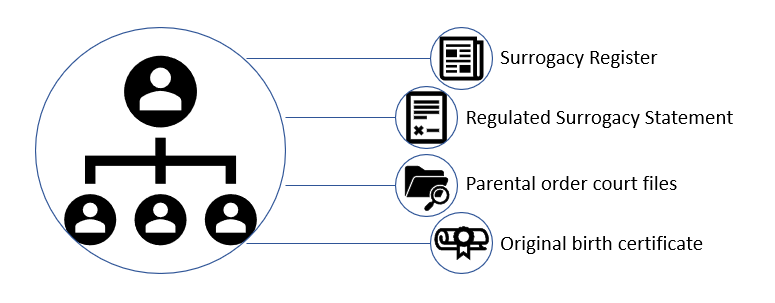
At present, relevant information relating to the surrogacy arrangement is contained in three places:
- Birth certificate: as the birth register is public, anyone can make a request for information. This can be done at 18 years old in England and Wales, and 16 in Scotland. However, in England and Wales, whilst anyone can make a request for a birth certificate, there is no link between the parental order certificate that is issued following a parental order and the original birth certificate, as is the case with adoption certificates and parental order certificates in Scotland.
- The Final Report contains a recommendation for surrogate-born individuals to be able to access their original birth certificate in England and Wales, as is already possible in Scotland. The Law Commissions have recommended that this be implemented with retrospective effect, thus allowing individuals to access the record in instances where the parental order was granted before the new legislation comes into force, on the basis that the inability to access the record appears to stem from a mistake or oversight in a change of process in 2010. It is also recommended that the age of access align with access to the Surrogacy Register, and as detailed in the figure above.
- Court records: an individual can make an application upon reaching 18 years old to access records relating to the parental order case. These records would include all relevant documentation, apart from statements filed during proceedings in England and Wales.
- The Final Report recommends that all files relating to the parental order to be available to the surrogate-born individual, with the offer of counselling prior to access, at the same age as access to the Surrogacy Register.
- For cases that proceed on the new pathway, there would not be any court records due to the intended parents being the legal parents from birth. To ensure that the surrogate-born individual’s ability to access information is parable across the pathway and parental order cases, it is recommended that the Regulated Surrogacy Statement (explained in an earlier post) is held on a Register by the HFEA. This would be accessible on the same basis as the court files.
- HFEA Register: where donor gametes are used, or where the surrogate’s eggs are used in traditional arrangements, their information is stored on the HFEA Register in circumstances where treatment took place in a UK licensed clinic. Non-identifying information is available at 16 years old, and identifying information (for gametes donated after 1 April 2005) at 18 years old.
- Although the HFEA Register was outside the remit of the project, the Law Commissions did suggest that the HFEA and Department for Health and Social Care evaluate their current rules about age of disclosure. Should the recommendations relating to the Surrogacy Register be adopted, this would be important to ensure alignment between the two schemes.
Initial Observations
The recommendations relating to accessing information are thorough and wide-ranging. It is really positive to see a rights-based approach being adopted in the Final Report, focusing on the surrogate-born child’s legitimate rights and interests in obtaining such information. The move towards access on the basis of maturity, as opposed to an arbitrary age imposition, is also really positive in recognising a child’s vital interest in the information.
There are, however, challenging aspects to the recommendations. The right to such information inevitably requires a balance with other interests and rights, such as to privacy and family life. Further, the complex matrix within which relevant information is held means that some of the recommendations go beyond strictly the remit of the project. Reforms to the birth registration procedures and the HFEA Register would require further consideration and consultation before being achievable.

 reforming surrogacy law
Leave a reply to International Rights Frameworks: Are the Law Commissions recommendations for reform conforming to international legal standards? – reforming surrogacy law Cancel reply