Changing the way in which legal parenthood is allocated following a surrogacy arrangement is one of the key recommendations proposed by the Law Commissions’ report and draft bill. Allowing the intended parents to be legal parents from birth would be a fundamental change from the existing legal framework and, therefore, a large part of the final report addresses the practicalities and processes that would need to be in place for the new pathway to operate. The Law Commissions stated:
Allowing legal parental status to be acquired by a purely administrative process on the birth of the child is a fundamental shift from the current legal position. The system of regulation implemented must therefore be sufficiently robust to protect the welfare of the surrogate-born child, to ensure that the surrogate is safe and not exploited, and to ensure that surrogacy is the right decision for the intended parents and the surrogate.
Law Commission, Full Report (page 33).
It is clear that the pre-conception processes and safeguards would be fundamental to the new pathway operating effectively in order to protect the key parties involved: the surrogate, the intended parents, and most importantly, the child.
This post brings together some of the key aspects of the recommendations to chart, chronologically, how the new pathway would progress. In doing so, information is being drawn from Chapters 2, 4, 6, 8 and 9 of the Full Report.
What is the new pathway?
The new pathway would shift the determination of legal parenthood following surrogacy from a post-birth judicial decision to a pre-conception administrative process. Provided that all eligibility criteria are met and pre-conception screening and checks take place, a Regulated Surrogacy Statement (RSS), discussed further below, would be signed by all parties prior to conception. The RSS would then operate to allow the intended parents to be recognised as the surrogate-born child’s legal parents from birth. This is subject to the surrogate’s right to withdraw consent at any time after treatment commences until 6-weeks post-birth. The effect of the surrogate’s right to withdraw is dependent upon when it is exercised, and this is discussed in more detail later.
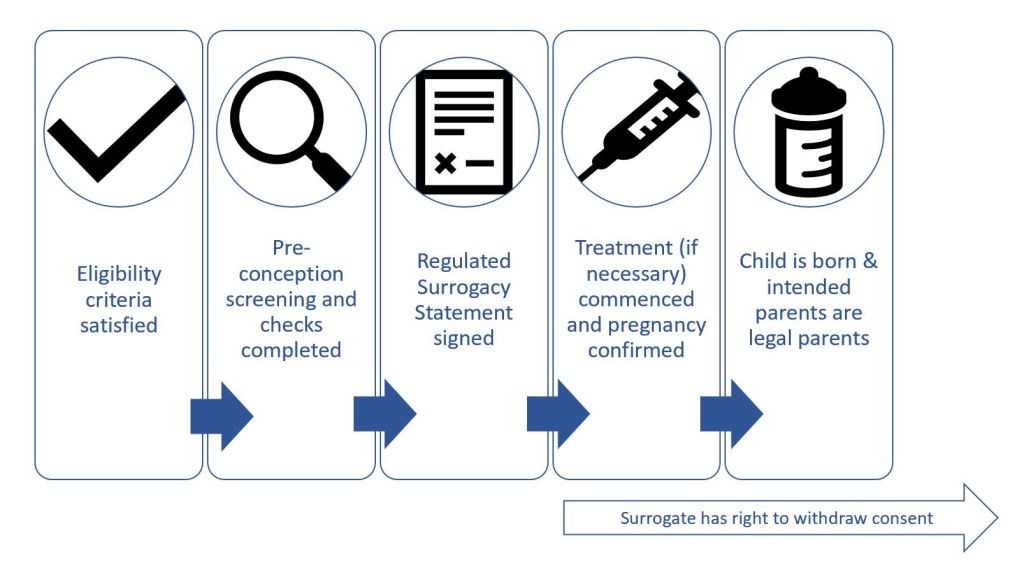
Eligibility
A previous post has provided an overview of the eligibility criteria for the new pathway, compared with the existing legal framework and recommended revisions to the parental order requirements.
As acknowledged in the Report, it is important that any eligibility criteria strike the correct balance between establishing certainty and ensuring respect of the surrogate’s autonomy and the best interests of the child. The Report only recommends four eligibility criteria. These criteria, however, are defined as ‘bright line rules’ seen to serve an essential role in regulating the scope of surrogacy:
- Age imposition: under the current legal framework, intended parents must be at least 18 years old to obtain a parental order. The continuation of this minimum age is recommended. It is further recommended that a new minimum age requirement be imposed: the surrogate must be at least 21 years old at the time of entering into the agreement. This was justified on the basis of ensuring they are sufficiently mature, both physically and emotionally, to make the decision.
- Genetic link: despite consulting on the possibility of allowing double gamete donation in cases of medical necessity, the Report has recommended the retention of the requirement for a genetic link between the child and at least one intended parent.
- Relationship status: for two applicants, the requirement for them to be in a close relationship (married, civil partners or in an enduring family relationship) is retained.
- Domicile or habitual residence: retaining a connection to the UK as a requirement, an alternative test of habitual residence is recommended alongside domicile.
Pre-conception processes
At present, there is no legal requirement in relation to pre-conception screening or checks. As the determination of parenthood following surrogacy is post-birth, the only pre-conception checks that take place are those mandated by the clinics providing treatment. In order to ensure that all parties are adequately protected and informed before entering into a surrogacy arrangement, various pre-conception checks and safeguards are recommended:
- A health check of the surrogate, to ensure she is fit for pregnancy and to identify any particular health risks to her, as well as an STI test for the surrogate and her partner, as well as any intended parents providing gametes.
- Implications counselling for the surrogate and intended parents, to discuss the full consequences of the agreement.
- Independent legal advice, whereby the lawyer can tailor the advice to the interests of the client.
- A criminal record check of the surrogate, her partner, the intended parents and anyone over 18 years old who lives with the intended parents. This would check for offences against children, those involving pornography or sexual offences, fraud, and deception.
- Provision of life and critical illness insurance for the surrogate, paid for by the intended parents, to last for at least two years from the point of treatment.
- An assessment of the welfare of the child, which may be completed by the Regulated Surrogacy Organisation (RSO) or the treating clinic.
- Provision of information relating to the surrogate, intended parents and gamete donors, for entry to the surrogacy register.
The RSO would be responsible for ensuring these checks have taken place, with regulatory sanctions if not. A separate post will explore the status and role of the RSO in more detail.
The Regulated Surrogacy Statement
The RSS would be the unequivocal record of the agreement, signed by the surrogate, intended parents and Regulated Surrogacy Organisation (RSO). Once signed, the surrogacy agreement could commence under the new pathway, with the effect being that the intended parents obtain legal parenthood from birth.
As a result of consultees’ comments, it is recommended that a standardised form be used for the RSS, keeping costs down and ensuring consistency.
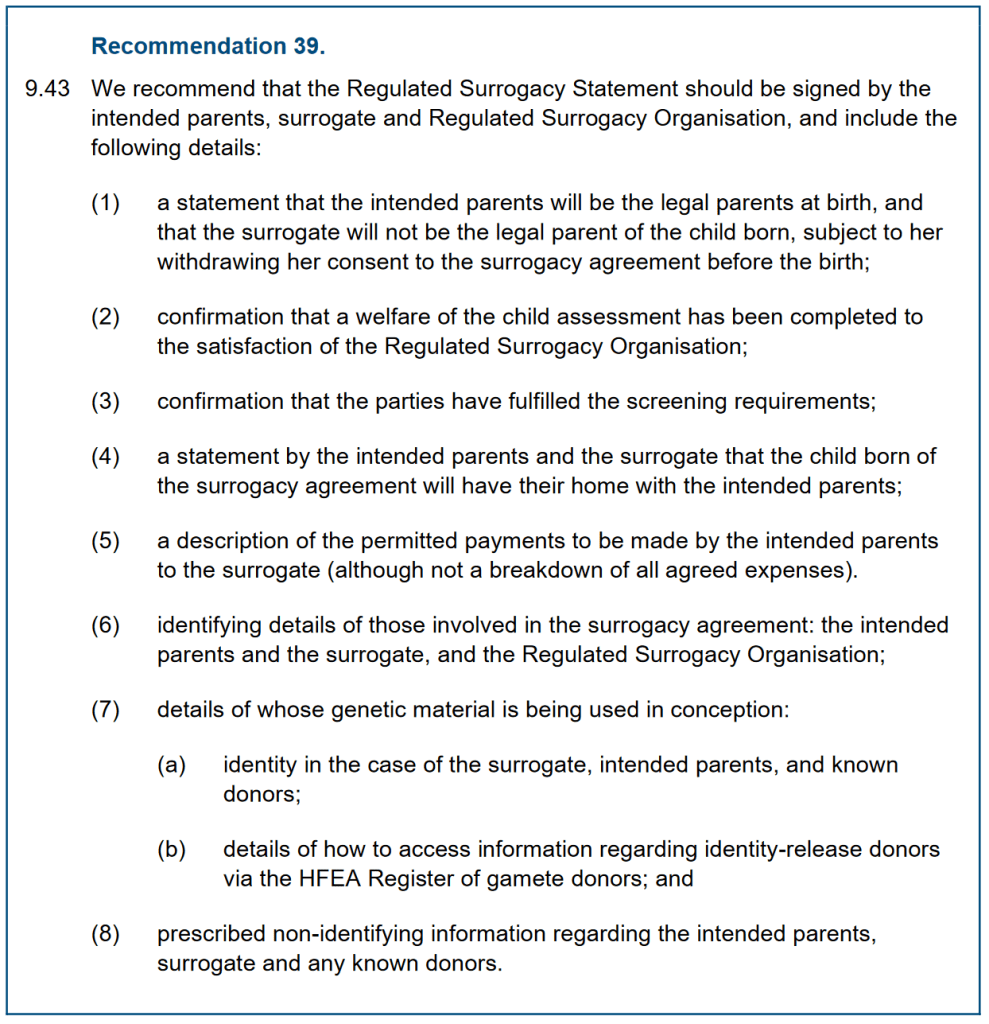
The purpose of the RSS is three-fold: it records relevant information about the parties, confirms compliance with the pre-conception checks, and provides evidence of the parties’ intentions. Importantly, however, it is not an enforceable contract.
Recommendation 39 (shown below) details what information would be required within the RSS:
Surrogate’s right to withdraw
Despite mixed comments from consultees on this point, the Report recommends that the surrogate retains a right to withdraw her consent after the RSS is entered into.
Originally termed as the ‘right to object’ in the provisional proposals, the ‘right to withdraw consent’ was seen to more accurately reflect the legal implications of the surrogate’s decision: making a declaration that she is no longer providing her ongoing consent to the intended parents being recognised as the legal parents of the child. The withdrawal of consent would need to be in a recorded format, such as written or recorded, and given to both the intended parents and RSO.
The right to withdraw consent begins from the time of treatment, but the impact of her withdrawal of consent would depend upon when it takes place:
- Before the child is born: if, after treatment has taken place and before the child is born, the surrogate exercises her right to withdraw her consent, she will be the legal mother from birth (although her spouse would not be a legal parent, as is currently the case). The intended parents would be required to apply for a parental order once the child was born, and the judge would decide on the basis of the best interests of the child.
- After the child is born, up to 6 weeks: if the surrogate exercises her right to withdraw consent after the child is born, the intended parents would remain the legal parents as this crystallises at birth. The surrogate would be required to apply for a parental order, and it would again be a best interest determination by the court.
- Once the child is over 6 weeks old, the surrogate’s time frame to exercise her right to withdraw consent would end and she would not be able to challenge legal parenthood.
When will the arrangement not be under the new pathway?
Whilst it is hoped that the new pathway will capture the majority of surrogacy arrangements, it is important to note that there will be circumstances which fall outside of its scope.
One key restriction to the pathway is that the surrogacy arrangement must be domestic in nature – this means that if the surrogate is not domiciled or habitually resident in the UK, or the treatment took place outside of the UK, the pathway would not be an option. Similarly, if anonymous gametes are used, this too would exclude the arrangement from following the pathway. Given the high prevalence of cross-border surrogacy arrangements, there will inevitably remain a group of intended parents who are unable to benefit from these recommendations.
It is for this reason, as well as cases that begin on the pathway but with a subsequent withdrawal of consent from the surrogate, that the parental order process must be carefully scrutinised to ensure the best interests of the child can be met.

 reforming surrogacy law
Leave a reply to Case Update: Refusal of step-parent adoption order following surrogacy (Re Z (Surrogacy: step-parent adoption)) – reforming surrogacy law Cancel reply