Since the last post in early April, there has been various developments in relation to the surrogacy reform recommendations and judicial decisions. This post summarises these developments, all of which demonstrate that surrogacy (and in particular international arrangements) continues to be an important area for consideration – raising various public policy concerns.
A Government Response: Letter from DHSC
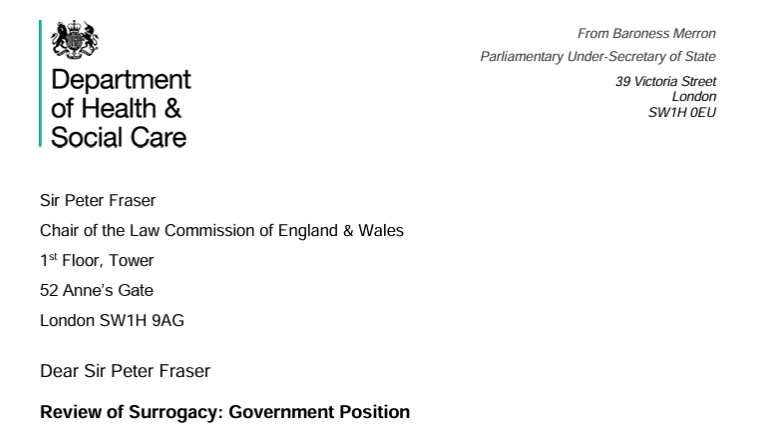
On 10th April 2025, the Parliamentary Under Secretary of State for the Department of Health and Social Care sent a letter to the Law Commissions. Falling short of a final response, which was anticipated within 12 months of the Full Report and Draft Bill being published, the letter explains that the Government is not currently in a position to prioritise surrogacy reform. As such, there was an explicit statement that the Government did not intend to put forward the proposals at this time. A final government response is still awaited.
In light of the high-profile cases that have been published and reported in the time since the Full Report, this confirmation of the new Government is – whilst not surprising – disappointing.
In April and May alone, there have been numerous other reported judgments which continue to demonstrate the issues that may arise when surrogacy is practiced without appropriate measures in place to ensure public policy concerns are not realised. These cases are summarised below:
Mr W v Ms S & Another [2025] EWFC 85: consent, criminal allegations and welfare
In Mr W v Ms S & Another, the intended father had entered into a surrogacy arrangement with a clinic based in Northern Cyprus and a Kyrgyzstan surrogate. Owing to some of the similarities with the case of Re Z (Unlawful Foreign Surrogacy: Adoption), summarised here, Theis J directed that a copy of her judgment be sent to the relevant Government departments that participated in the Re Z case. The judgment focused on two key issues: the surrogate’s consent, and criminal allegations against the intended father.
Consent
The clinic chose the surrogate without any involvement from the intended father, and he understood that he was to have no direct contact with the surrogate. The written agreement specified that direct contact with the surrogate was prohibited. As such, the intended father never met the surrogate.
As regards obtaining consent for the parental order, the clinic did not cooperate with requests for further information, making it difficult for the surrogate’s consent to be confirmed. The court gave directions for the Children’s Guardian to make her best attempts to obtain consent from the surrogate: this took place via video call, and the Children’s Guardian was satisfied that the surrogate understood, and consented to, the parental order.
Based on all the actions taken and the history of documents provided to the court, Theis J was satisfied that the surrogate had effectively given her consent.
Criminal allegations and welfare concerns
At the same time that the intended father was engaging with the surrogacy process, his wife – from whom he was separated – made allegations against him of sexual offences. He was arrested and released pending investigation. Upon the parental order application being made, Cafcass safeguarding checks revealed that he had been charged with two other offences of battery (having been arrested for common assault of his wife) and aggravated harassment/stalking. The earlier charges were never prosecuted, and the sexual offences case was closed by the police after his wife withdrew her support to the investigation.
Owing to these police reports, Cafcass made a safeguarding referral to the local authority and produced a risk assessment to the court: the local authority closed the case with no further action, concluding there was no risk to the child.
Notwithstanding these allegations, and the intended father’s admission of his mental health history, the Children’s Guardian was satisfied that he posed no risk to the child and understood the implications of his actions. As such, the parental order was granted on the basis that it would satisfy the child’s lifelong welfare needs in maintaining the close relationship she has with the intended father.
Mr & Mrs X v Ms Z [2025] EWFC 71: consent
Mr & Mrs X v Ms Z, factually similar to Re H (Anonymous Surrogacy) – the summary of which is available on this blog –, concerned a surrogacy arrangement undertaken in Nigeria with an anonymous surrogate.
Whilst most of the s 54 requirements for a parental order were not problematic for the court, it was necessary for a more detailed consideration of whether the surrogate could be said to have consented to the parental order, as required by s 54(6) HFE Act 2008. The intended parents did not meet the surrogate, either before entering into the arrangement or during the pregnancy, although they were present for the birth. However, the surrogate had signed affidavits confirming her consent, and the parental order reporter was able to have a telephone meeting with the surrogate, during which she confirmed that she gave her consent to the parental order being granted. As such, Theis J was satisfied that there was the necessary consent under s 54(6).
Despite granting the parental order, Theis J, reiterating the warnings made by the President of the Family Court, Sir Andrew Macfarlane, in Re H, emphasised how:
Every step should be taken by intended parents to avoid engaging with any surrogacy arrangement that proposes an anonymous surrogate, or even one that seeks to limit the intended parents contact with the surrogate. Any such lack of transparency is likely to impact on this court’s ability to be able to assess any consent being relied upon, which could result in a parental order not being made (para 7).
As discussed in an earlier post, the anonymity of the surrogate poses issues, not only in terms of obtaining consent for the purposes of a parental order, but also in ensuring the child’s right to identity can be realised.
Mr & Mrs K v Mr and Mrs Z: welfare and intended parents’ age
The case of Mr & Mrs K v Mr and Mrs Z dealt with the welfare implications of a surrogacy arrangement entered into by intended parents of advanced age. The intended parents were each 72 years old, and had engaged with surrogacy in California. Whilst the judge was satisfied that all s 54 requirements were satisfied, enabling a parental order to be granted, there remains concerns about the effect that the intended parents’ age may have on the welfare of the child.
Given that the court must be satisfied that the child’s welfare, throughout his life, would be satisfied through the granting of a parental order, Knowles J gave directions for further information to be provided on the practical arrangements that had been put in place should either (or both) intended parent die or become incapacitated.
Based on the arrangements put in place by the intended parents, the court was satisfied that the welfare of the child did demand that the parental order be granted. These arrangements included arrangements for a nanny, boarding school, guardianship, and lasting powers of attorney.
The judgment was delicate in its approach, emphasising that:
It is not the purpose of this judgment to moralise about the wisdom of having a baby through surrogacy at an advanced age, but this court can and should ensure that the arrangements for that child’s future care have been thought about, planned and actioned in case the worst should happen (para 28).
As with the case of Re Z (Unlawful Foreign Surrogacy), this case highlights how the welfare of the child requires a balance between giving effect to the child’s lived reality and ensuring their long-term welfare needs will be satisfied.

 reforming surrogacy law
Leave a comment