In June 2024, I presented a paper at a conference hosted by the Centre for Cultures of Reproduction, Technologies and Health at the University of Sussex, looking at the cultural and social ideas that underpin the language and practice of surrogacy legislation.
My presentation, titled ‘Best interests as a rule of procedure: reflection on different regulatory responses to surrogacy’ focused on how different jurisdictions have justified their approach to surrogacy regulation from a best interests narrative. From this presentation, a paper was developed and published today in Amicus Curiae.
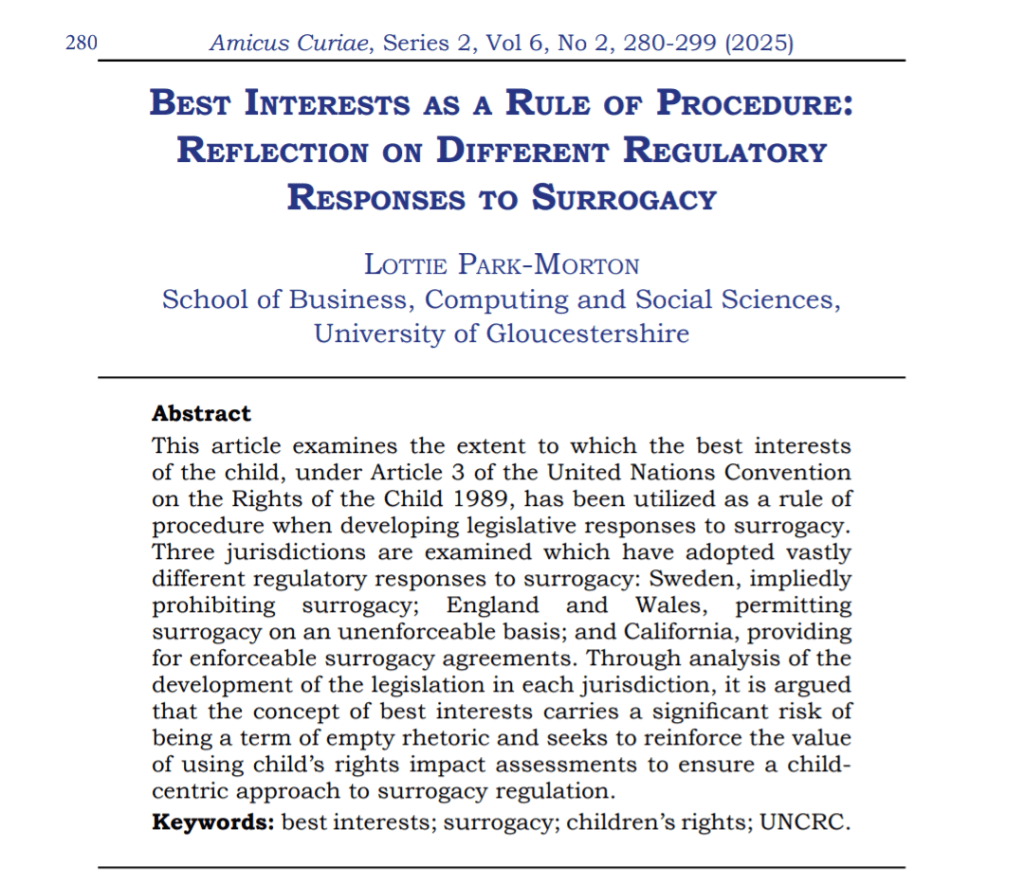
The United Nations Convention on the Rights of the Child demands that, in all decisions concerning children, their best interests be the primary consideration. This obligation on States, contained within Article 3, applies as a rule of procedure, thus meaning that when implementing new legislation, there must be consideration as to how the legislative approach will align with the best interests of the child.
To examine the extent to which the best interests of the child has been used in the development of regulatory responses to surrogacy, I examined three jurisdictions with differing approaches to surrogacy regulation: England & Wales, which permits surrogacy on an unenforceable basis; Sweden, which does not allow surrogacy within the legal framework; and California, which permits surrogacy and operates on an intent-based model.
My research finds that the concept of best interests, as an inherently flexible notion, has the potential to be manipulated to justify regulatory responses that are not truly child-centric. As such, I conclude that:
It is imperative that BI remains a fluid concept, allowing for legislation to be developed that is culturally and contextually appropriate. However, this does not mean that BI can continue to be used in the unsubstantiated manner evidenced in this article.
This article contains important lessons in the future regulation of surrogacy, both in England & Wales and beyond. If, and when, the law comes to be reformed, it is essential that there are appropriate, and substantive, arguments made based on the rights of the child. It is recommended that, to achieve this, child rights impact assessments are utilised.

 reforming surrogacy law
Leave a comment