The risks associated with international surrogacy arrangements are well known, and as outlined by Theis J in the case of Re Z (Foreign Surrogacy), summarised in an earlier post, intended parents must proceed with caution and obtain appropriate guidance when embarking on such a surrogacy journey.
Nonetheless, two reported judgements from this month (February 2025) demonstrate the continued issues that may be encountered. In X v W & Another, Theis J had to consider whether a parental order could be granted despite concerns over the nature of the arrangement and payments that had been made. In Re Z (Unlawful Foreign Surrogacy: Adoption), a parental order could not be granted, owing to the lack of a genetic link, and Sir Andrew Macfarlane had to consider whether adoption orders could be made despite the potential exploitation evident in the arrangement.
These cases vividly demonstrate the issues that can be encountered when intended parents cross-borders to engage with surrogacy. The lack of international regulation of surrogacy means each country has differing rules and standards, which will sometimes not be compatible. This can result in issues relating to parenthood, immigration rules and nationality.
X v W & Another
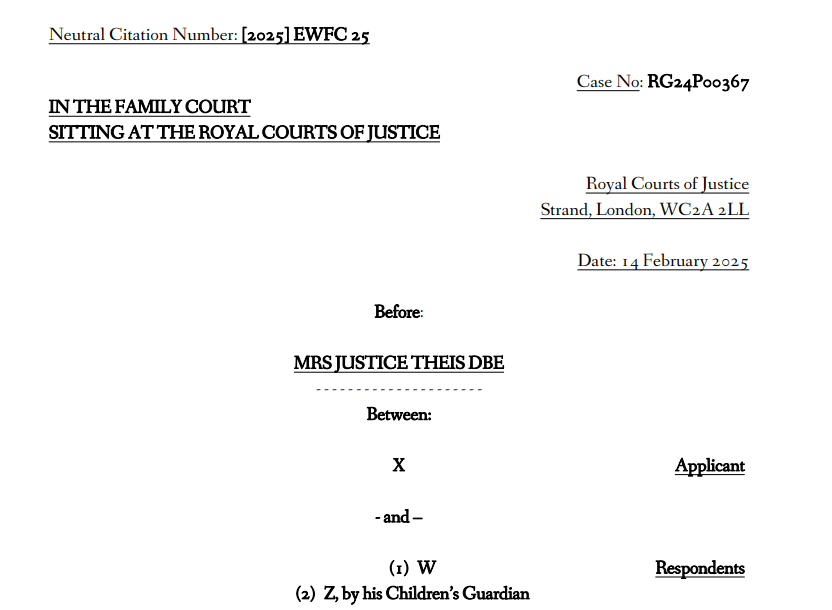
In this case, an intended parent, the genetic father of the child, entered an international surrogacy arrangement with a clinic based in Northern Cyprus and agency registered in Israel. The surrogate was from Kyrgyzstan, and the intended father understood that the birth would take place in the Czech Republic. However, despite attempts by the intended father for alternative arrangements, the child was in fact born in Moldova. Moldova does not permit surrogacy, and the intended father was not made aware of this fact until he arrived for the child’s birth, at which point he was told he must act as if he were the surrogate’s partner. The intended father did not seek legal advice due to the expense, and was not informed by the Agency as to any legal complexities that may arise.
This dynamic, similar to the Re Z case, demonstrates the initial complexity that may arise with international surrogacy arrangements. As Theis J stated:
From what the court has seen it appears there was scant, if any, consideration given by X of the complexities of the arrangement he was entering into and neither were the potential difficulties and risks properly highlighted by the Clinic or the Agency in their dealings with X. Both the Clinic and Agency are operated as commercial organisations (para 4).
The intended father was able to return to the UK with the child and sought a parental order. Of the s 54 HFE Act 2008 parental order criteria, two required further consideration by the court:
- S 54(6) requires the consent of the surrogate to the granting of the parental order. Despite issues with the completed paperwork, Theis J was satisfied – based on the ongoing communication between the surrogate and intended father and the Children’s Guardian’s conversation with her, that she had freely and unconditionally consented to the order being made.
- S 54(8) states that, unless authorised by the court, no more than reasonable expenses can have been paid in relation to the arrangement. The payments made by the intended father to the agency are itemised in the judgment, totalling 37,143 EUR. The surrogacy agreement detailed that the surrogate would receive 13,500 EUR as compensation for her ‘help and monthly support costs’. Despite some conflicting evidence as to the payments that had actually been made to the surrogate, it was accepted that such payments were made to her.
As to the public policy issues raised by the case, Theis J stated:
In my judgment X was extremely naïve in entering into this surrogacy arrangement without being absolutely clear what the arrangements were regarding where the child was going to be born, and what his rights were in relation to that. He was also naïve about gaining any proper understanding of the relevant legal frameworks in the jurisdictions that were relevant to this arrangement (para 39).
Nonetheless, Theis J was willing to authorise any payments beyond reasonable expenses. It would seem, as with many cases of this nature, that the court’s ultimate approach was driven by the welfare of the child: it was deemed that granting a parental order would secure the child’s relationship with the intended parent, meeting his lifelong welfare needs.
Re Z (Unlawful foreign surrogacy: adoption)
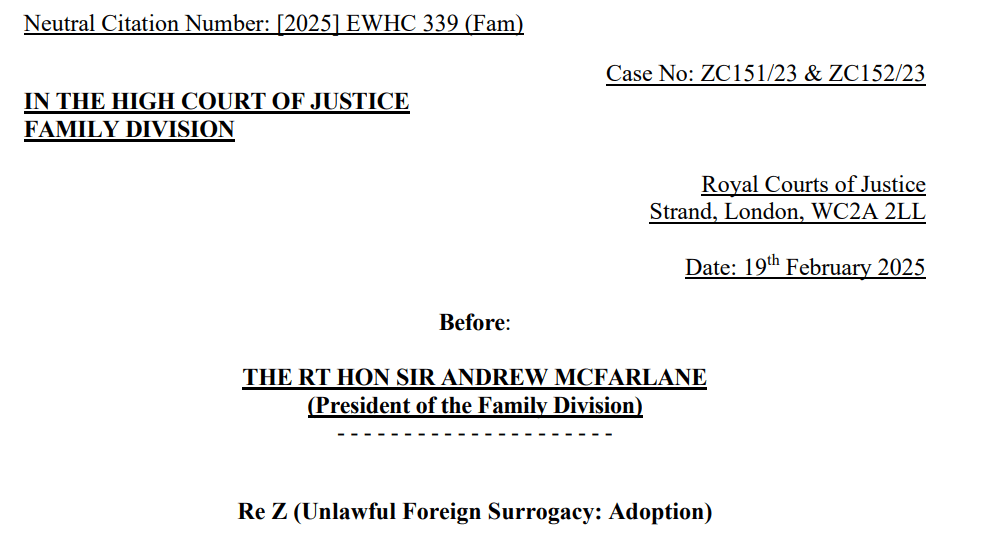
This case saw intended parents enter surrogacy arrangements in Northern Cyprus, a jurisdiction that does not permit surrogacy nor same-sex parentage. Embryos were formed using donated eggs and sperm, and two separate surrogates were engaged. This meant that the two children were full genetic siblings, but had different gestational parents. The children also had no genetic link to the intended parents as double gamete donation had been used.
After the children had been born, issues started to arise. Firstly, there were problems with registering the birth of the children and they were, in effect, stateless, not able to establish nationality either through their place of birth or through their birth mother’s nationality. Secondly, and resultantly, the Home Office refused to allow the children to enter the UK. After the First-tier Tribunal granted the application under Article 8 European Convention on Human Rights, they were able to enter the country. However, this process took four years.
S 54(1)(b) HFE Act 2008 requires that there be a genetic link between at least one intended parent and the child in order for a parental order to be granted. As such, parenthood could not be established by way of a parental order. Instead, the intended parents were seeking to formalise the relationship with the children through adoption orders.
The fact that the children were stateless meant that adoption would significantly benefit them, through giving them British nationality. Furthermore, there were no individuals with parental responsibility for the children: other than the intended parents, the only options would have been the local authority or High Court in wardship. Neither would be a desirable outcome.
As such, and in line with the local authority social worker and Children’s Guardian, an adoption order was granted. However, there were remaining concerns that warrant consideration within the judgment:
- First, a ‘significant’ feature of the case was that one of the applicants was over 70, and the other was ‘fast approaching that age’. There are welfare implications to this, given that by the time the children are in their early teens, one parent will be in her 80s. Sir Andrew Macfarlane stated that:
It is surprising that two individuals embarking upon this process had not given any consideration to those matters because, to someone standing outside, the need to understand the impact on the children of the age difference is very plain (para 21).
Although there are no age restrictions in relation to becoming a parent by way of adoption or surrogacy, there are welfare implications. Nonetheless, the court was satisfied that appropriate provision had been put in place for the children’s care should it be required.
2. Secondly, in order for an adoption order to be made, the birth mother must consent to the order or else such consent can be dispensed with on the basis of the child’s welfare. The surrogates were not identifiable: they only knew the first name of the surrogates, and the clinic had refused to provide any information. As such, the requirement for consent was dispensed with.
3. Finally, although not directly addressed in the judgment, there are also questions raised from the judgment in relation to the payments made. There is a prohibition on payments being made in relation to adoption. Nonetheless, in the judgment it was specified that payments made in relation to the surrogacy arrangement totalled around £120,000 – as Sir Macfarlane stated, even allowing for the fact that the arrangement included two surrogates and two children, this was ‘a very significant amount of money. It was, in reality, a commercial rate, rather than one that simply sought to recover the surrogates’ expenses’ (para 8). Although the payments made directly to the surrogates was lower, it is still notable that the adoption order was granted despite evidence of financial transactions relating to the agreement.
Implications for future cases
In the concluding paragraph of the Re Z judgment, Sir Andrew Macfarlane issued a strong warning that individuals who consider entering a commercial foreign surrogacy arrangement should be prepared for the court to refuse an adoption or parental order,
with the result that the child that they have caused to be born may be permanently Stateless and legally parent-less. Put bluntly, anyone seeking to achieve the introduction of a child into their family by following in the footsteps of these applicants should think again (para 35).
However, to date there has been no case where a parental order (or adoption order) has been denied because of the nature of the international arrangement.
The warning is an important one: there are risks to all parties of the arrangement, and the resulting child, when appropriate safeguards are not in place. Nonetheless, once the child has been born, it is difficult to envisage a situation where the court would refuse to recognise the relationship between the intended parents and the child: the paramountcy of the child’s welfare means that, where refusal of such order could leave the child parentless and stateless, arrangements would still need to be put in place. Ultimately, the child is the most important concern of the court, and the one least to blame as to the nature of their birth.

 reforming surrogacy law
Leave a comment