In the recent case, Re H (Surrogacy: step-parent adoption), rather than granting a parental order, the court– at the request of the intended parents – granted a step-parent adoption order. The decision is significant in highlighting the respective benefits of each order. Whilst both orders effectively transfer legal parenthood from the surrogate to the intended parent, on the facts it was agreed that the step-parent adoption order would better meet the lifelong welfare needs of the child.
The difference between a parental order and step-parent adoption order
As discussed in an earlier post, parental orders were specifically designed to transfer legal parenthood from the surrogate (and her spouse where applicable) to the intended parents.
Where the surrogate is not married, it is possible for one intended parent to be a legal parent of the child from birth. However, in order for both intended parents to be recognised as legal parents, a parental order must be sought. The effect of this is that the surrogate’s legal parenthood is removed and replaced with the other intended parent. Even in cases of a single intended parent, a parental order is still required to ensure the surrogate’s legal parenthood is removed.
The effect of a parental order has been regarded by the court as having a ‘transformative effect’, being seen as the appropriate mechanism to properly reflect the reality of the child’s birth and life. Upon the grant of a parental order, the original birth certificate is replaced with the parental order certificate, listing the intended parents as the legal parents.
In contrast, a step-parent adoption order involves the partner of a legal parent being recognised as a legal parent, extinguishing the other parent’s legal parental status. In a surrogacy context, this would have the same practical effect of removing the surrogate’s legal parenthood in order to recognise an intended parent, who is not a legal parent, as such. Upon the grant of a step-parent adoption order, a new birth certificate is issued, replacing the original birth certificate and naming the new legal parent.
The courts have, on multiple occasions, considered that an adoption order is not an appropriate mechanism for establishing legal parenthood following surrogacy because it does not accurately reflect the role of the intended parent in the child’s conception and life.
Therefore, the case of Re H is novel in the intended parents’ request for a step-parent adoption order to be granted instead of a parental order, despite the requirements under s54 HFE Act 2008 for a parental order being satisfied.
The context
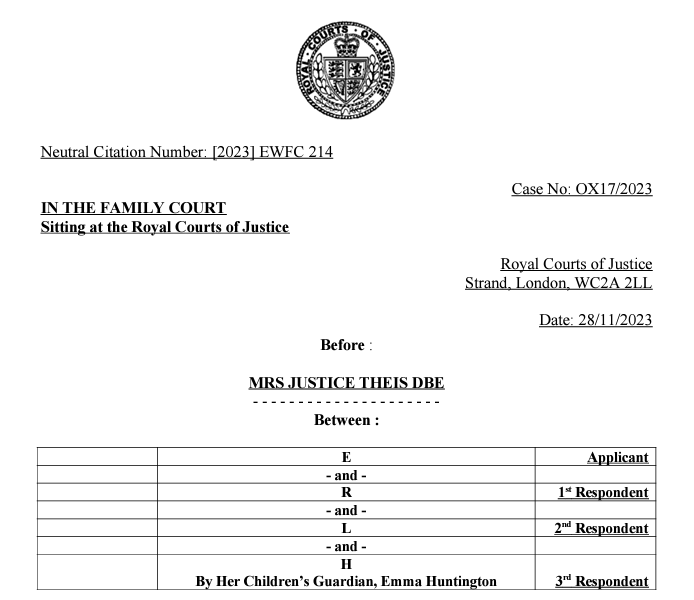
The intended parents, despite being habitually resident in the UK, were both born in Argentina, where the surrogacy arrangement took place. Following the child’s birth, both intended parents were registered as the child’s legal parents on the Argentinian birth certificate. At the time, they were unaware of the need to regularise their legal parental status in the UK.
In this jurisdiction, ‘L’, the genetic intended parent of the child was a legal parent, along with the surrogate. When the intended parents became aware of the need to apply to court to remove the surrogate’s legal parenthood and establish the non-genetic intended parent, ‘E’, as the legal parent, one significant factor became apparent. E held Italian citizenship, and it was important for the intended parents for this citizenship to pass to the child.
In Italy, a restrictive approach is taken to surrogacy. The intended parents were advised by the Italian authorities that a parental order would not be able to be registered in Italy so as to recognise the intended parents as the child’s legal parents, and thus the child would not acquire Italian citizenship through the parent-child relationship with E. A birth certificate issued pursuant to a step-parent adoption order, however, would be recognised by the Italian authorities.
It was therefore submitted by the intended parents that a step-parent adoption order, allowing Italian citizenship to be granted, would ensure an ‘important part of [the child’s] identity and life story’ [28].
The decision
Theis J commenced the judgment by outlining the practical and symbolic differences between a parental order and step-parent adoption order. It was acknowledged that either order would ensure the child’s legal parenthood reflected their lived reality, but stated that a step-parent adoption order would not ‘fully reflect the circumstances of her birth in the way that a parental order does’ [33]. This is because an adoption order fails to reflect the circumstances of the surrogacy birth – in that the intended parent had been the planned parent of the child since before conception.
Notwithstanding this, the step-parent adoption order was granted on the basis of the child’s lifelong welfare needs, with it being recognised that the order would enable the child to have their Italian heritage ‘recognised in a tangible way’. This was seen to align with the child’s welfare, given that recognition of her Italian heritage would align with her ‘sense of identity and the family culture’ [35].
In concluding that a step-parent adoption order was appropriate on the facts, Theis J combatted any argument that failure to grant a parental order would mean the child’s background is not properly reflected in the order. Despite adoption orders not being the usual mechanism for establishing legal parenthood following surrogacy, Theis J stated that the child would understand the circumstances of her conception given the ongoing relationship between the family and both the surrogate and egg donor. As such, the adoption order would not distort the child’s reality due to her awareness from an early age as to the nature of her birth.
Discussion
This is not the first case where adoption has been used as a mechanism to establish legal parenthood following a surrogacy arrangement. It is, however, the first reported case where an adoption order has been granted despite the intended parents being eligible for a parental order. In earlier cases where adoption orders have been granted, it has been due to one of the s54 HFE Act 2008 requirements not being satisfied, such as the intended parent(s) not having a genetic link to the child, or the surrogate not providing consent to the parental order.
This case therefore demonstrates the utility that adoption orders may have in surrogacy arrangements, beyond being the default option where a parental order is not necessary. However, as Theis J emphasised in this case, and as has been stated in earlier cases, adoption orders were not envisaged to apply to a surrogacy context and fail to recognise the unique aspect of surrogacy arrangements given the intended parents’ role since before birth. Nonetheless, for the child it is clear that this was the preferable outcome, allowing legal parenthood to be established for the intended parent whilst also allowing her heritage to be given full effect in Italy.

 reforming surrogacy law
Leave a comment