In December 2022, I presented a paper at the Future Directions in Surrogacy Law conference considering the genetic link requirement within s54 Human Fertilisation and Embryology Act 2008. At the time of the conference, the Law Commission had provisionally proposed removing the genetic link requirement in cases of medical necessity. I had argued that the exception should apply more broadly, on the basis of the formative role that non-genetic intended parents play in a surrogate-born child’s identity.
When the Law Commissions published their Final Report in March 2023, their position on the genetic link requirement changed. The recommendation is to retain the genetic link requirement in order for intended parents to be recognised as legal parents, both on the new pathway and when applying for a parental order.
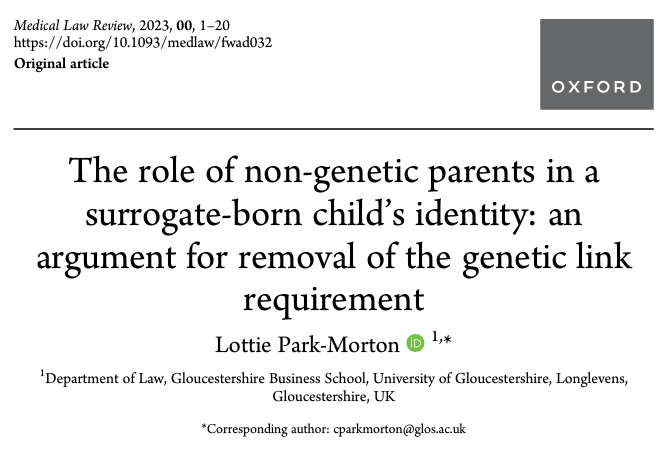
On the basis of research I have undertaken into domestic case law and the judgments of the European Court of Human Rights, I argue that retaining the genetic link requirement fails to adequately respect the child’s identity rights. In an article, published in the Medical Law Review this week, I have laid out these identity-based arguments.
The article first considers what it meant be ‘identity’ as a right of the child, framed around the United Nations Convention on the Rights of the Child and European Convention on Human Rights, before analysing how the judiciary, in domestic case law, have articulated the role of non-genetic intended parents in the child’s identity. I have then explored some circumstances where the genetic link requirement may be problematic, thus preventing intended parents from being recognised as the legal parents. The final part of the paper reflects on the Law Commissions’ project, including both the provisional proposals and final recommendations, concluding that the requirement should be reconsidered in light of the child’s identity.
The article is available online now.

 reforming surrogacy law
Leave a comment