The issues around the birth registration process following a surrogacy arrangement are multifaceted, where ensuring the rights and recognition of all parties involved is crucial. The social issues surrounding birth registration in surrogacy arrangements extend beyond the legal framework. They encapsulate deeply personal and emotional experiences, societal norms, and values, and potentially effects on identity formation for surrogate-born children. Thus, this blog post explores the Law Commissions’ recommendations for reform of birth registration following surrogacy, considering both their preferred and alternative models.
Under the current law, given that the surrogate (and her spouse, if applicable) will be the legal parent at birth, she is required to register the birth and will be listed as the child’s legal parent on the birth certificate. This birth registration is then re-recorded following a parental order, detailing the intended parents as the child’s legal parents.
Under the recommendations made by the Law Commissions in the Final Report, the intended parents would be the child’s legal parents from birth if the surrogacy journey was completed on the new pathway. As such, it is important that the child’s birth registration is consistent with their lived, and legal, reality of parenthood.
The Law Commissions have recommended that intended parents following the new pathway be able to register the child, and be recorded as the child’s parents on the birth certificate. This approach is coherent with wider recommendations and better reflective of the intention of all parties involved in the surrogacy journey. However, it does not align with the UK Government policy that the person who gives birth must be named as the mother on the birth certificate.
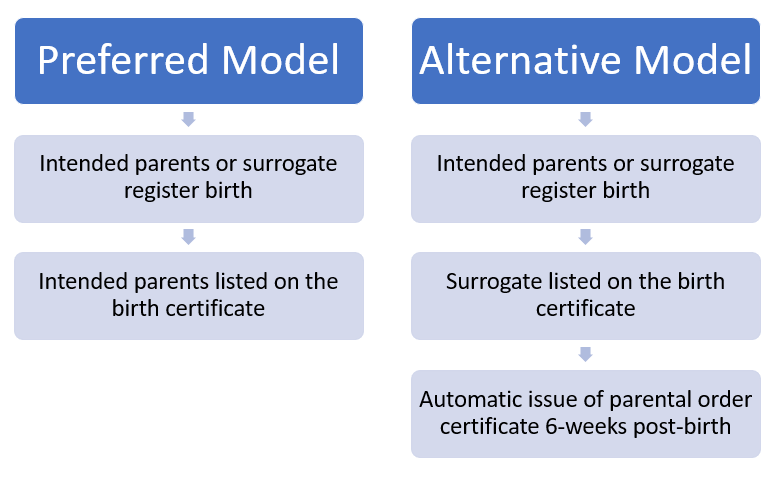
Therefore, the Law Commissions has put forward two models for birth registration in surrogacy: the “Preferred Model”, which is designed to meet the needs of the child, the surrogate, and the intended parents; and the “Alternative Model”, which attempts to provide the best outcomes for all parties while still respecting UK government policy.
The Preferred Model
Provisional Proposal:
In the 2019 Consultation Paper, the ‘Preferred Model’ was put forward as a provisional proposal. This model would operate so that the intended parents could register the child’s birth and be named as the parents on the birth certificate.
In order to allow the surrogate to exercise her right to withdraw consent, the proposal was to allow that withdrawal of consent for one week less than the applicable birth registration period (which differs between England & Wales and Scotland). If the surrogate does not withdraw her consent, intended parents would be free to register the birth as the child’s parents within the final week of that period.
Final Report:
This approach changed after the consultation period. In the Final Report, the Law Commissions’ recommendations retains the position of intended parents as the legal parents at birth. However, under the recommendation, intended parents can instead register the child’s birth during the standard birth registration period, complying with Article 7 of the United Nations Convention on the Rights of the Child (UNCRC), which requires immediate registration of the child after birth.
Importantly, the recommendation for the Preferred Model removes the link between the surrogate’s right to withdraw consent and birth registration. This therefore prevents different rules operating dependent upon where the surrogacy arrangement took place.
At the point of the intended parents registering the birth, they would be required to make a declaration to the Registrar that the surrogate had not withdrawn consent at the point of registration. If the surrogate did subsequently withdraw her consent, a parental order by the surrogate would need to be sought.
Ultimately, the recommendation for the Preferred Model of birth registration provides a clearer process for registering births after surrogacy, reflecting the intention of ll parties whilst also ensuring compliance with international child rights standards.
The ‘Alternative Model’
The Alternative Model, which the Law Commissions recommended to reflect Government’s current policy in relation to the definition of a ‘mother’, would involve the surrogate being registered as the legal mother on the birth certificate. However, despite being registered as the legal mother on the birth certificate, she would have legal parent status unless she had withdrawn her consent before birth.
This would therefore result in a misalignment between the birth certificate and the legal parenthood of the child.
In order to ensure the birth certificate accurately reflects the child’s legal reality, the recommendation is for – at the end of the period in which the surrogate can withdraw consent – an automatic parental order to be issued to the intended parents, without any positive action being required on their part.
Like the Preferred Model, the intended parents can act as informants to the birth registration, provided that the Regulated Surrogacy Statement and a declaration confirming the surrogate did not withdraw her consent before birth is provided to the registrar. Alternatively, the surrogate can also act as informant, providing the Regulated Surrogacy Statement.
The alternative model is primarily aimed at addressing the Government’s concerns over maintaining the coherence of the birth registration system. However, it is not the Law Commissions’ preferred approach due to two key reasons:
- It fails to address the preference of intended parents and surrogates for the intended parents to be named as parents on the original birth certificate.
- It would require the General Register Office/National Records of Scotland to devise a process for the automatic issuing of the parental order certificate, which could bring in operational challenges.
In the words of the Law Commissions in their Core Report:
This approach would address the UK Government’s concerns about maintaining the coherence of the birth registration system, but we think it does not best meet the needs of surrogates, intended parents, or surrogate-born children, or fit coherently with our policy for the new pathway.
Core Report, page 41.
An overview of the Final Report Recommendations:
Concluding comments
The Law Commissions’ recommendations provide a fresh perspective on birth registration, tailoring it to the modern family unit. The Preferred Model, as outlined by the Law Commissions, attempts to streamline the birth registration process by allowing intended parents to be registered as legal parents from the outset. It strikes a balance between the parties, represents the intention of all parties on the surrogacy journey, and complies with international child rights standards.
The Alternative Model, whilst respecting the UK Government’s policy on birth registration, could result in complexity and undue burden. The automatic parental order and subsequent processes would potentially be confusing and results in a situation where the birth register and legal parenthood do not align.
Resultantly, the Preferred Model will provide a more simplified and direct process to birth registration. It will be for the Government to decide which, if any, approach to adopt.
Finally, the Law Commissions also suggest, for both the Preferred and Alternative Model, that the surrogate’s name be recorded on the Surrogacy Register, along with the intended parents and information about any gamete donor. This would be the case regardless of whether she withdraws her consent or not. Therefore, the surrogate-born child would be able to access the identity of their surrogate if they choose, whilst affording the intended parents the same legal rights as traditional families. This will aid the child with their sense of identity, and is compliant with Article 7 of the UNCRC.

 reforming surrogacy law
Leave a comment