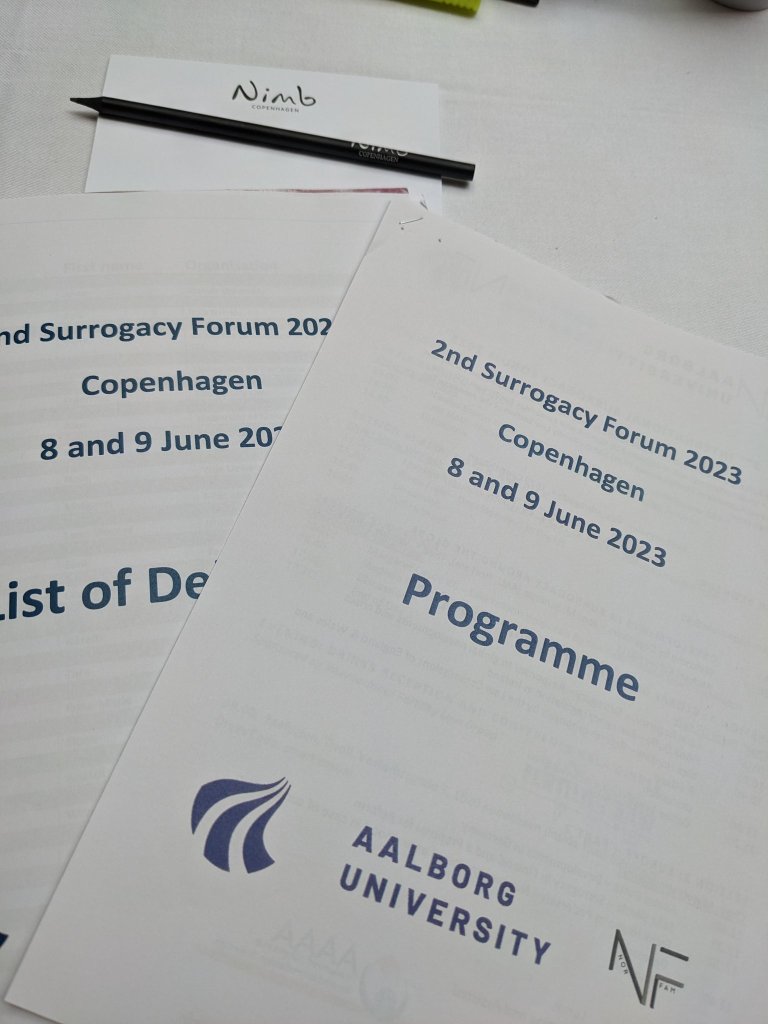
Earlier this month, the 2nd International Surrogacy Forum took place in Copenhagen, providing an opportunity for academics, lawyers and clinicians from around the world to come together and share current practices and insights into the regulation of surrogacy within their jurisdiction. Hosted by Aalborg University, and the Nordic Centre for Comparative and International Family Law (Norfam), it was co-organised with Cambridge Family Law, the International Academic of Family Lawyers and the Family Law Section of the American Bar Association.
Surrogacy in the UK
Included amongst the speakers were Nick Hopkins, the Law Commissioner responsible for Surrogacy at the Law Commission, providing an overview of the recommendations made in the Final Report, along with academics who have done empirical work on surrogacy in the UK, including Kirsty Horsey, speaking about her findings of a survey undertaken with surrogates, and Katherine Wade, presenting findings on the Children’s Voices in Surrogacy Law project.
These presentations, providing a UK-context, highlighted some of the key features of the current law, including the importance of altruism in surrogacy practice, the approach that should be taken in relation to payments to the surrogate, and the process relating to the allocation of legal parenthood.
With various academics and practitioners from the UK in attendance at the conference, these presentations provided current insights and sparked debate around the likelihood of the recommendations from the Final Report being implemented by Government.
The global perspective
With each continent represented, the Forum provided a unique opportunity to hear about the extent to surrogacy is regulated (or not) and practised across the globe. With speakers from Germany (Anatol Dutta), Finland (Salla Silvola) and Denmark (Frank Pedersen) providing an overview of the prohibitive approach taken to surrogacy within the jurisdictions, it was a timely reminder that across Europe there is far from a consensus on whether surrogacy should be permissible. However, the presentations also emphasised what we know to be true from the case law of the European Court of Human Rights (ECtHR) – that if a State fails to facilitate surrogacy as a reproductive option, there is the potential for intended parents to cross-borders and engage with surrogacy in a permissive jurisdiction. This poses issues in relation to the attribution of parenthood, a theme across the entire Forum and discussed in more detail later in the post. Fiona Duffy also spoke of the proposed surrogacy legislation in Ireland, which would allow for domestic altruistic surrogacy: the Bill, currently under redrafting, would provide both pre- and post- birth approval processes in order to recognise the intended parents as legal parents.
From a presentation providing an overview of approaches to surrogacy in Latin America by Nicolas Espejo Yaksic, it was clear that there is far from a standardised approach to regulation. Some States prohibit the practice, others allow it within defined parameters, and some were defined as ‘tolerating’ the practice by failing to regulate the surrogacy arrangement itself but dealing with the consequences in terms of legal parenthood. However, even within these diverging responses, it was stated that there are common themes that pose issues in regulating surrogacy across Latin America, such as structural inequalities and class discrimination within society. The regulation of surrogacy in Latin America is considered in more detail in a book recently published with Intersentia and launched at the conference.
In relation the USA, Bruce Hale provided a visual representation of different States approaches to the regulation of surrogacy, clearly demonstrating a lack of uniform approach across the country. From enforceability of surrogacy contracts, to permitting genetic surrogacy (where the surrogate is also the genetic parent) and compensation to be paid to the surrogate, it was clear that each State had developed a separate legal framework. There were separate sessions relating to New York specifically, which has recently moved towards a permissive regulation of surrogacy, with Denise Seidelman providing an overview of the new framework, and Richard Vaughn exploring the regulation of surrogacy agencies.
From Oceania, Margaret Casey spoke of New Zealand moving from a tolerant towards a regulatory approach to surrogacy, and Stephen Page explored the differing approaches across each State within Australia to the practice. A common theme across these two presentations was the perception that both States were moving towards a more permissive approach to surrogacy. In New Zealand, there is a report and private members bill that would move surrogacy practice towards a regulatory approach whereby a parentage order could be granted to intended parents, avoiding the need for adoption orders. In Australia, some States still criminalise the practice of surrogacy, although there have been no convictions, and individual States have undertaken incremental changes to regulation over the years. In a separate session, Judge Alex Harland from Australia spoke of the importance of ensuring the child’s right to identity and lived reality to be upheld in judicial determinations of parenthood following surrogacy.
Julia Sloth-Nielsen, providing an overview of Africa, spoke of the cultural aspects affecting the practice of surrogacy, including the stigma attached to infertility. In a brief overview of how different African countries deal with surrogacy, it was clear that some States permit surrogacy and make provision for its consequences, such as Ghana and Kenya, whilst other countries, such as Uganda and Nigeria, have no current regulation but see surrogacy happening in practice.
From Asia, the law in India was discussed by Lavanya Fischer. As Lavanya stated, India moved from a system of ‘no regulation to heavy regulation’ resulting from high-profile cases that led to a desire to prevent foreign intended parents accessing surrogacy within India. The new law, effective from 2021, permits surrogacy only on an altruistic basis, in circumstances where the intended parents are both genetically related to the child and have been married for five years, and where the surrogate is a ‘close relative’ of the intended parents. It appears that the implication of this new law is that Indian intended parents are now travelling overseas to get engage with surrogacy.
What was apparent from these presentations was that diverging views and approaches to surrogacy are not geographically-based. Even within a continent, and indeed within a country, different frameworks are in place – some that permit and encourage surrogacy as a practice, some that seek to actively prohibit the practice, and others that deal with the consequences of surrogacy rather than providing a legal framework for its regulation. It could not have been clearer that surrogacy remains a divisive ethical issue, making any prospect of a uniform approach to regulation highly unlikely.
A book published by Intersentia in 2019, Eastern and Western Perspectives on Surrogacy, explores these diverging approaches across jurisdictions.
Topical issues in surrogacy law and practice
Within the Forum, as well as hearing about individual States’ approaches to the regulation of surrogacy, there were also presentations and discussions around current events and work being done at an international level to regulate surrogacy.
Colin Rogerson, the first to speak at the conference, provided an overview of the impact of recent global events on surrogacy practice. Starting with Covid-19, Colin spoke of how the pandemic affected those engaged in surrogacy arrangements, due to not being able to get to the child or able to bring the child to their home country as a result of travel restrictions and quarantine requirements. However, despite those challenges, a positive development occurred: the move to remote court hearings was easier and cheaper, and a practice that may well continue. Secondly, the conflict in Ukraine was spoken of, with the impact of the invasion on surrogates, their families and the intended parents’ ability to get to the children.
From a European perspective, Alina Tryfonidou provided an update of the case law from the European Court of Justice (ECJ) and ECtHR on the cross-border recognition of legal parenthood following surrogacy. Whilst the ECtHR has laid down minimum standards in relation to recognition (particularly of genetic intended parents), the ECJ case law is more limited in scope, applying only to recognition where it is for the purposes of exercising the right to free movement within the EU.
From a global perspective, Cristina Gonzalez Beilfuss, working with the Hague Expert Group on the Parentage/Surrogacy Project, provided an update on the work of the Group. With its mandate being to explore the feasibility of an instrument on parentage and surrogacy, it is unsurprising that there were diverging views across the Group. The report of the Expert Group was submitted in March this year and recommended continued work on reaching consensus on cross-border recognition of parentage. However, whilst there continue to be strongly held views on the desirability of surrogacy as a practice, reaching a consensus on recognising parenthood seems challenging.
Themes of the conference
Across the two-day conference, several themes appeared to emerge. Despite the vastly varying approaches towards surrogacy across the globe, there were particular issues that came up on numerous occasions.
First, the importance of language and terminology regularly arose. In particular, the use of the phrase ‘surrogate mother’ was contested on the basis that surrogates do not see themselves as mothers. There was recognition of this by various speakers, including Nick Hopkins who said the Law Commission had actively decided not to use this phrase because of those concerns. Another linguistic issue repeatedly referred to was the pitching of ‘altruistic’ as the opposite of ‘commercial’ when discussing the type of surrogacy arrangement. As many attendees commented, payments being made does not necessarily remove any altruistic motive within the arrangement, and payment alone is not an accurate indicator of a commercial arrangement. This highlights the importance of being sensitive around the language being used, and acknowledging how translation may impact on this.
Furthermore, there were repeated references throughout the Forum to the importance of the surrogate born child’s access to information relating to the surrogacy birth. With various countries legislating, or proposing legislation, for children to be able to access information about the surrogate and any genetic parent, there appears to be recognition across the board of the significance for a child in having such information. This is supported by empirical research, and also aligns with the United Nations Convention on the Rights of the Child, and, in the UK context, has been discussed further in an earlier post.
Another theme that emerged across the Forum was the limited effectiveness of domestic law when surrogacy practice is becoming increasingly global. Where States prohibit or limit the practice, intended parents are more likely to cross borders in order to access surrogacy. The resultant child’s best interests and rights must be protected, and therefore most States – even where they prohibit the practice within the jurisdiction – have some method for recognition of parenthood, ensuring the child is not left stateless or with limping parentage. As such, any prohibition could be argued as counter-productive.
Finally, and perhaps most prevalently, my lasting impression from the Forum goes back to a basic point: that surrogacy remains divisive, will split opinion, and thus makes legislating very challenging. There is no one common approach to the regulation of the practice, with extremes of complete prohibition – often premised on preventing exploitation – and active and supportive regulation – based on reproductive liberty and autonomy of women. Nonetheless, it appears that, regardless of how a State chooses to regulate surrogacy, the practice will continue, whether within a legal framework, under the radar, or across borders.

 reforming surrogacy law
Leave a comment