As part of the Law Commissions recommendations in the Final Report, they have anticipated that the new pathway would include the following aspects:
- Matching potential surrogates with intended parents, and vice-versa;
- Intended parents and surrogates obtaining independent legal advice if they choose;
- Ensuring implications counselling takes place for surrogates, her spouse or partner, and the intended parents;
- A written surrogacy arrangement between the parties.
However, the aforementioned elements of the new pathway are currently governed by the Surrogacy Arrangement Act 1985 (SAA), which has been said by the Law Commissions to take a “tolerant” approach to surrogacy. The SAA criminalises commercial surrogacy by prohibiting professionals (for example lawyers or counsellors) from charging clients seeking advice or support in relation to surrogacy, and by placing restrictions on the advertisements of surrogacy arrangements. As such, the current statutory framework within the SAA would restrict Regulated Surrogacy Organisations (RSOs) and other permitted bodies from fulfilling their anticipated roles under the new pathway due to the threat of criminal sanction. Resultantly, the Law Commissions have recommended that the provisions of the SAA be reformed in relation to certain bodies.
The specified activities, and where the Law Commissions focussed their recommendations include:
- Matching and facilitation of surrogacy arrangements
- Advertising of surrogacy arrangements
- Charging for negotiation and advisory services.
This post will lay out the current provisions under the SAA and illustrate the issues it would pose to RSOs under the new pathway, before analysing the recommendations in the Final Report.
The current legal framework: matching, negotiating and advising
S.2 provides that surrogacy arrangements may be viewed as commercialised if a person or body:
- Initiates negotiations to make a surrogacy arrangement
- Contributes to negotiations with a view to the making of a surrogacy arrangement
- Offers or agrees to initiate negotiations of a surrogacy arrangement
- Collects any information with a with a view to the making, or negotiating the making, of a surrogacy arrangement
- Knowingly causes another to do any of these acts on a commercial basis.
These acts will be deemed as commercialised and criminalised in law, if for the purposes of S.2:
- Any payment is at any time received by himself or another in respect of it, or
- One acts with a view to any payment being received by himself or another in respect of making it, or negotiating or facilitating the making of, any surrogacy arrangement.
Therefore, S.2 of the SAA provides that a person who contributes to the making of a surrogacy arrangement and receives payment or acts with the intent of receiving payment will be committing a criminal offence (under S.4). It is notable that this does not apply to the surrogate or intended parents, thus aimed at preventing third parties from profiting from the surrogacy arrangement.
In practice, S.2 could hinder surrogates and intended parents from accessing good-quality support and advice by requiring that the relevant professionals must conduct their services without making profit.
The recent case of XX v Whittington Hospital NHS Trust (2019) clarified that it is not an offence for someone to negotiate a commercial surrogacy arrangement overseas. Therefore, this legislation is not applicable to international surrogacy arrangements.
The current legal framework: advertising
S.3 of the SAA provides that it is an offence to publish specific advertisements about surrogacy in the UK. Advertisements that are covered by the prohibition include:
- Advertising that a person is, or may be, willing to be a surrogate; or
- Advertising that a person is looking for a surrogate.
This blanket prohibition applies to all common methods of advertising, including newspaper, television, radio, and the internet as per S.3(3). Therefore, surrogacy arrangements cannot be advertised lawfully. This may be problematic in the context of the new pathway as RSOs, and other organisations, may be required to advertise their services to match parties.
The current legal framework: sanctions
S.4 of the SAA establishes the criminal sanction for a breach of the foregoing provisions (S.2 and S.3). S.4 provides that a breach of the Act could result in a custodial sentence up to three months. However, the Law Commissions stated in their Final Report that they were unaware of anyone being charged under S.4 of the SAA, therefore rending this legislation largely ineffective. Additionally, this infers that the existing legislation is likely routinely breached, as there is no effective system of regulation. It has been noted that S.3 of the SAA, the prohibition of advertisements is often breached online. This is worrying as a lack of regulation within surrogacy leaves scope for commercial, and potentially exploitative, surrogacy arrangements.
Reforms recommended in the Final Report
Matching services
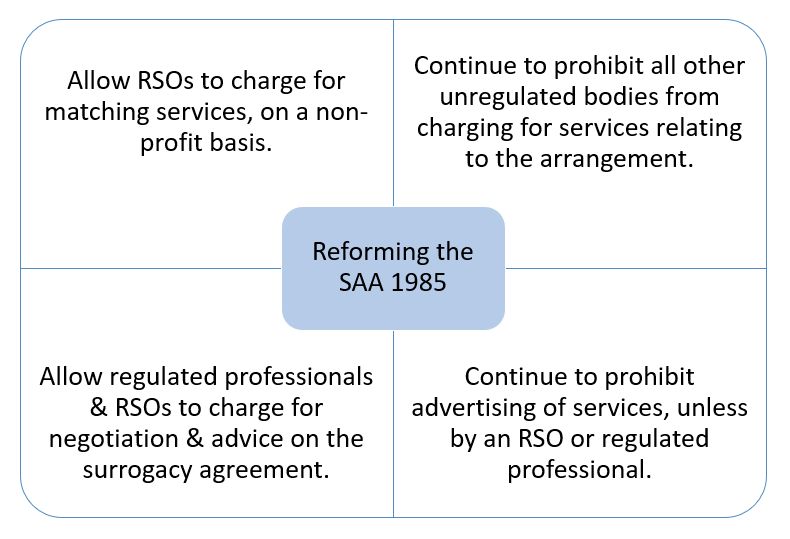
Within the Final Report, the Law Commissions recommended that one of the key roles of RSOs would be to provide “matching services”. This is directly prohibited under S.2 of the SAA 1985 as currently drafted. However, under the new pathway, RSOs, and other non-profit organisations, may conduct matching services, subject to conditions. Specifically, the Law Commissions recommend that only RSOs may charge for their matching services, as they will be regulated by the HFEA. Whilst other organisations could offer matching services, they would not be able to charge for this serbice.
Charging for negotiating and advising on surrogacy agreements
S.2 and S.3 of the SAA present a barrier to surrogacy arrangements, with the Law Commissions recognising how parties are left to “stumble” through their agreements. Although it is not recommended in the Final Report that surrogacy teams must obtain legal advice in relation to the drafting of surrogacy arrangements, they should have the option to do so. This should be distinguished from obtaining legal advice relating to the arrangement as a whole in the new pathway, which would be mandatory.
In the Final Report, it is recommended that the prohibition from S.2 is removed, allowing regulated legal professionals, as specified by the Secretary of State, and RSOs to charge for negotiating and initiating surrogacy agreements. Despite this change, the existing prohibition will remain for unregulated and unapproved bodies, and it will continue to be a criminal offence for anyone else to charge to negotiate or advise on surrogacy agreements.
Advertising surrogacy arrangements
The current criminalisation of advertising has been labelled as ‘the worst constraint in the SAA 1985’. It is routinely breached online, with people advertising their willingness to undertake, or search for, a surrogacy arrangement unregulated. In the 2019 Consultation Paper, the Law Commissions provisionally proposed that the ban on advertisements of surrogacy agreements be lifted entirely. However, their Final Report withdraws from this approach. Instead, it is recommended that RSOs, along with other professionals (such as lawyers, clinicians and counsellors), should lawfully be able to advertise their services. These regulated professionals could be held to account by the relevant professional body (being the HFEA in relation to the RSO) for the nature of their advertising.
Any unregulated organisation which provides matching services, or any unregulated professional, would continue to be prohibited from advertising their services under the SAA. The criminal offence present within the current law would therefore continue to apply to these individuals.
Thoughts on the recommendations
In conclusion, the Law Commissions’ Final Report concerning surrogacy matching services, legal advice, and advertisements, proposes a legal route for RSOs to be more facilitating to their clients. The reforms of the SAA 1985 and easing of criminal prohibition for approved bodies under the recommendations provide that properly regulated organisations would be free from the shackles of S.2 and S.3, allowing them to be more actively involved in the initial stages of a surrogacy arrangement. This recommended change would be beneficial in allowing for intended parents and surrogates to no longer ‘stumble’ through the process on their own, but instead be appropriately and transparently supported within the new pathway.
Further, the Law Commissions appear to strike a fair balance between retaining the tone of S.2, ensuring that surrogacy agreements are retained as free from commercialisation. Although RSOs and other regulated bodies may now receive payment for specified services, the privilege of decriminalisation would only be for approved and regulated bodies and professionals, thus ensuring that intended parents and surrogates will not be subject to unreasonable charges from unregulated organisations.

 reforming surrogacy law
Leave a comment