The recommendations within the Law Commissions’ Final Report relating to the allocation of legal parenthood following a surrogacy arrangement centres on establishing a new pathway. Provided that the surrogacy arrangement is eligible to progress on the new pathway, and that all safeguards are met, the intended parents would be recognised as the legal parents from birth. A full breakdown of the recommendations for the pathway have been considered in a separate post. Central to the new pathway would be the Regulated Surrogacy Statement (RSS): if the Regulated Surrogacy Organisations are the gatekeepers to the new pathway, the RSS is the gateway.
The role of the RSS
The Final Report refers to the RSS as acting as a ‘clear and unambiguous’ record of the agreement between all parties to the arrangement. The surrogate, intended parents and Regulated Surrogacy Organisation (RSO) would need to complete and sign the statement, with the RSO’s signature constituting approval for the surrogacy arrangement to progress on the new pathway.
The Law Commissions outlined what they perceived the role of the RSS to be:
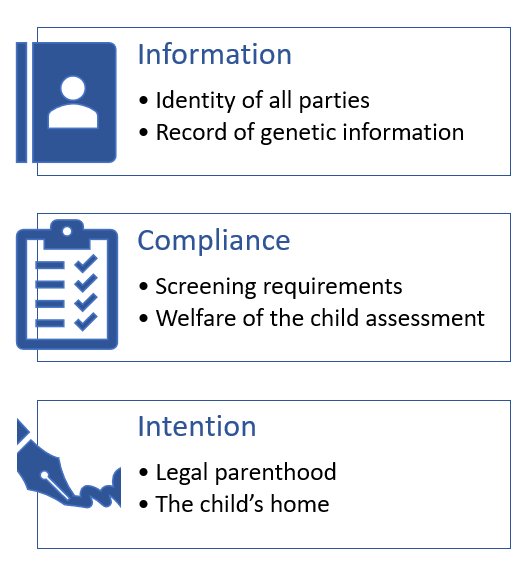
The Regulated Surrogacy Statement will fulfil three purposes: it will set out key information regarding the parties to the surrogacy agreement; it will confirm that the parties have complied with all the screening and safeguarding, and administrative, arrangements of the new pathway; and it will provide evidence of the parties’ shared intention that the intended parents are to be the legal parents at birth.
Law Commissions’ Final Report, page 242.
It is therefore clear to see that the RSS has multiple functions:
- First, it would detail information relating to all parties of the surrogacy agreement. This means that information relating to the surrogate, intended parents, gamete donor (if applicable) and RSO would be documented. This information would then need to be provided by the RSO to the Human Fertilisation and Embryology Authority (HFEA) for inclusion on the Surrogacy Register, allowing the surrogate-born child to have full access to this information.
- Secondly, the RSS would provide written confirmation that all the pre-conception screening and checks have taken place. A separate post has detailed what these pre-conception checks would include. Some checks would be undertaken by the RSO itself, whilst others by independent third parties: the RSO’s signature on the RSS is confirmation that these have been carried out appropriately.
- Thirdly, it would provide written evidence of the intention of all parties for the intended parents to be the legal parents, and for the surrogate-born child to live with the intended parents, from birth.
The role of the RSS would therefore be multiple-faceted. Ultimately, it would be a recorded declaration by all parties of their compliance with the relevant legal framework and intention for the arrangement to progress on the new pathway, with the effect being for the intended parents to acquire legal parenthood from birth.
The form of the RSS
In the 2019 consultation paper, the Law Commissions provisionally proposed that there should be no requirement for standardisation of the document, so long as there was a clear and unambiguous statement as to the parties’ intentions relating to legal parenthood.
However, based on consultee responses, it was concluded that a mandated and official form would be more straightforward, cheaper, and a more appropriate proof of consent. The exact format that the RSS should take, the Law Commissions recommended, should be prescribed in secondary legislation. However, the recommendation is that the RSS, as mandated, must be completed by all parties before commencing on the new pathway.
The content of the RSS
Due to the multi-faceted purpose of the RSS, the content that would be required ranges from factual information, to declaratory statements of intention and confirmation of compliance with legal requirements.
Provision of information
In relation to key information that would be required within the RSS, the recommendation stipulates that the details of all parties would have to be included. This would encompass the intended parents, the surrogate, and the RSO.
Further, the RSS would confirm whose genetic material was used, including any gamete donor. This means that the RSS would document which intended parent is genetically related to the child. In traditional surrogacy arrangements, the surrogate would also be explicitly identified as a genetic parent. For gestational arrangements with the use of a gamete donor, the information that would have to be provided would depend upon whether it was a known donor or identity release donor. In the case of known donors, the identity of the donor would be contained within the RSS. For identity release donors, the RSS would provide details on how to access further information relating to the donor through the HFEA Register.
Statements of intention
The RSS would be required to contain a declaration of the intended parents’ and surrogate’s intention for the intended parents to be the legal parents, and for the child’s home to be with the intended parents, from birth. This statement would also include recognition of the surrogate’s right to withdraw consent within the defined period.
Although this would not be an enforceable or binding statement, it is a clear declaration as to the intention of the parties when entering into the arrangement, and the Law Commissions saw value in its inclusion for this purpose.
Confirmation of compliance
In relation to ensuring compliance with the relevant legal requirements, the RSS would contain confirmation that all screening requirements have been satisfied. This would have to include an explicit statement from the RSO that a pre-conception welfare of the child assessment had taken place.
In addition, the RSS would be required to contain a financial annex. This would record a description of the permitted payments agreed between the intended parents and surrogate, along with an agreed limit to these costs.
What the RSS is not
The RSS is the gateway document allowing parties to enter into a surrogacy arrangement on the new pathway, and it is therefore of fundamental importance in recording intention and compliance.
However, it is important to emphasise what the RSS is not: it is not an enforceable contract or agreement. The labelling of the document as a ‘statement’ could be perceived as an attempt to distance it from a legal document that would carry enforceable obligations. In the event that there was a dispute about the arrangement, the RSS could not be relied upon as an enforceable agreement.
Given that the recommendations within the Final Report are centred on an aim to keep domestic surrogacy practiced on an altruistic, and non-commercial, model, ensuring that there are not contractual liabilities between the parties is of central importance. Whilst some elements of the payment agreement would be enforceable (as discussed in a separate post), this would not be related to the allocation of parenthood and would therefore be resolved outside of the RSS.
Furthermore, the Law Commissions emphasised in the Final Report that the RSS would not replace agreements that may already be entered into by parties to arrangements, such as agreements relating to lifestyle choices, birthing arrangements and contact. These ‘supplementary agreements’ could continue to be used outside of the RSS, and would similarly not be enforceable.
Commentary
Having a standardised and mandated RSS would ensure transparency and consistency for parties entering into surrogacy arrangements. It is clear to see that proper compliance with the RSS would be of fundamental importance in ensuring that the arrangement can progress down the new pathway. It is also apparent that the risk of improper completion of the RSS rests with the RSO: as will be explored in a subsequent post, the RSO could face regulatory sanctions for serious or repeated breaches. It will therefore be of priority for RSOs to ensure all mandated information and screening takes place prior to the all-important signature confirming the arrangement can enter onto the pathway.

 reforming surrogacy law
Leave a comment