The Law Commissions’ Final Report recommends establishing Regulated Surrogacy Organisations (RSOs), who would act as ‘gatekeepers’ to the new pathway to legal parenthood. The RSO would, in part, replace the current role of the courts in parental order applications by approving the surrogacy arrangement pre-conception, allowing the intended parents to be legal parents from birth. The RSOs would be regulated by the Human Fertilisation and Embryology Authority (HFEA) and could be subject to sanctions if they did not conduct their role correctly. The introduction of an official regulated body to approve surrogacy arrangements to the pathway could be seen as legitimising surrogacy as a practice, and would ensure that there are safeguarding measures for parties involved on the new pathway. Therefore the role of the RSO would be significant under the recommendations, and would enable a clear and accessible route to surrogacy.
Current law and practice
It was stated in the Final Report that RSOs would conduct similar functions as existing surrogacy organisations. Some key surrogacy organisations within the UK, and referenced by the Law Commissions, include Surrogacy UK, Brilliant Beginnings, and COTS. At present, a surrogacy organisation’s role generally includes helping surrogates find intended parents, and vice-versa; provide support for the parties throughout their journey; and offer advice in relation to finding professionals to work with and making parental order applications. The Law Commissions advocated that similar roles could continue to be undertaken by the RSOs, but with additional functions, which are discussed later.
Following a surrogacy arrangement, to remove the surrogate’s status as a parent and to recognise the intended parents as the legal parents of the child, the intended parents must apply for a parental order, which is a judicial process. Surrogacy organisations currently have no role in this process, other than offering guidance on the parental order application. Under the recommendations, the role of an RSO in relation to the allocation of parenthood would be crucial, removing – to an extent – the necessity for a judicial determination as to parenthood.
The role of the RSO
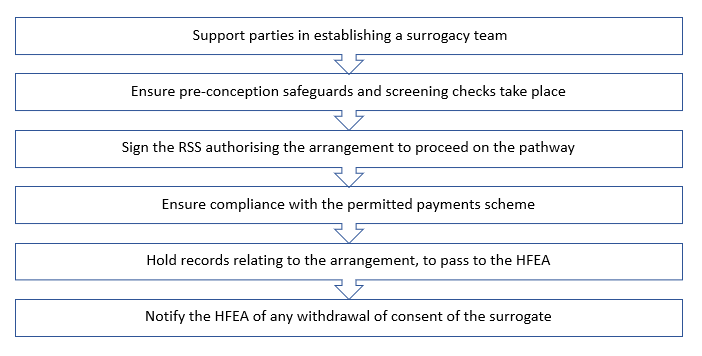
RSOs would play a crucial role in the new pathway. It would be the RSO’s authorisation, demonstrated through their signature on the Regulated Surrogacy Statement (RSS), that would allow the arrangement to proceed on the new pathway, thus recognising the intended parents as legal parents at birth, removing the requirement for a post-birth parental order.
Additionally, RSOs would guide the parties through the entire process, offering support and advice, as well as conducting the pre-conception formalities and screening processes such as ensuring implications counselling, medical screening, and criminal record checks have been completed. Through these roles, the RSOs would offer an element of security to the parties.
On the new pathway, the surrogate would be able to withdraw their consent up to 6 weeks post-birth. The RSO would also have a key function in this eventuality: the surrogate would need to inform the RSO of their withdrawal of consent, and this would be notified by the RSO to the HFEA as the regulatory body.
A final key role of the RSO would be providing oversight of the payments agreed and paid by the intended parents to the surrogate. The payment agreement would be annexed to the RSS, and the RSO would be responsible for ensuring these fall within the permitted categories of payments. If the intended parents made payments outside of the permitted scheme, the RSO would be required to refer this to an enforcing authority, and if the RSO did not comply with this framework, they could be subject to regulatory sanctions by the HFEA.
Main responsibilities
- Initiate surrogacy arrangements intended for the new pathway, for example matching the intended parents with an appropriate surrogate.
- Ensure the pre-conception safeguards and screening requirements are completed, including medical screening, implications counselling, independent legal advice and criminal record checks.
- Provide guidance and advice as to the rules relating to payments, and authorise the payment agreement (to be annexed to the RSS).
- Complete the RSS, prior to the child’s conception. The RSO’s signature on the RSS is their approval for the arrangement to commence on the pathway, ensuring the intended parents having legal parenthood on birth.
- In the eventuality that a surrogate withdraws her consent, inform the HFEA of this withdrawal, and provide appropriate support to the surrogate.
- Maintain information about the arrangement, including the RSS, information about the child of the child, a record of the surrogate’s withdrawal (if occurred), and the statutory declaration made by the intended parents as to payments.
- Within 12 weeks of the birth of the child, submit these records to the HFEA.
If the RSOs fail to conduct these responsibilities as required by law, the HFEA would be able to impose regulatory sanctions on the RSO, to the extent of their sanctioning powers at present.
“a person responsible”
The Law Commissions retained their provisional proposal to establish the role of “a person responsible” within an RSO. The person responsible would have to ensure that the RSOs are complying with the legal framework and HFEA’s regulatory scheme.
The person responsible would have six key duties:
- Acting as the contact point between the RSO and HFEA
- Managing the RSO with appropriate care and skill
- Ensuring the RSO complies with the legal framework
- Making appropriate arrangements for staff training
- Developing their own training and skills to fulfil their responsibilities
- Providing information about the RSOs conduct to the HFEA and other bodies as required
Notably, the HFEA did express concerns about whether the person responsible role would be too strenuous for one person to exercise; however the Law Commissions believe that this was due to a miscommunication on the training requirement, and remained of the view that this responsibility would best sit with one identifiable individual.
Structure of RSOs
The recommendation in the Final Report is for RSOs to operate on a non-profit basis. This means that the body would need to conduct its services without obtaining a profit. However, they would still retain the autonomy to pay their staff any wage they choose, deemed an appropriate safeguard for those employed within RSOs. Despite being non-profit, RSOs would still be able to charge a reasonable payment for initiating negotiations of a surrogacy agreement. A reasonable payment is defined by the Law Commissions as “a payment not exceeding the body’s costs reasonably attributable to the doing of the act.”
In relation to the organisational form of the RSO, the Law Commissions did not recommend any particular approach, allowing them to incorporate as, for example, companies, charities or trusts.
However, the recommendation is that the RSO must be an organisation. Within the consultation paper, the Law Commissions provisionally proposed that individual persons should be able to act as an RSO, subject to HFEA approval. However, this approach was departed from in the Final Report: it was viewed that there would be greater certainty and regulatory advantages to the RSO being an organisation, and therefore an individual person would not able to act as an RSO under the recommendations.
A further provisional proposal that was reflected upon in the Final Report, with the decision from the Law Commissions to not make a recommendation on, was the ability for a fertility clinic to operate as an RSO. However, as fertility clinics are profit-making in nature, consultees reported that this could introduce a financial incentive to accept parties onto the new pathway, thus risking commercialisation of domestic surrogacy agreements. Therefore, to ensure the recommendations maintained an altruistic approach to surrogacy, it was not recommended that fertility clinics could operate as RSOs in the Final Report. However, fertility clinics would be permitted to create a non-profit making “arm”, in which they would be able to act as an RSO, on the basis that the “arm” would be non-profit.
HFEA’s role as regulator
The HFEA currently regulate activity governed by the Human Fertilisation and Embryology Act 1990, therefore primarily fertility clinics and embryo research. The Law Commissions recommended that their regulation should also extend to RSOs, to oversee their conduct and ensure compliance with legal requirements.
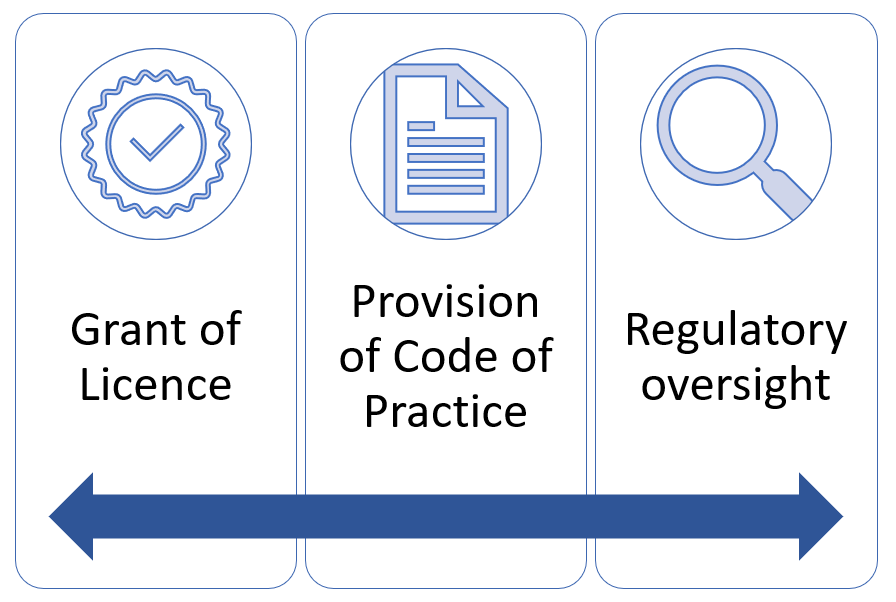
It would be for the HFEA to issue licences for RSOs to operate, and the RSO would need to meet licence conditions as set by the HFEA.
It is recommended that the HFEA provide guidance on RSO’s responsibilities through a new Code of Practice, tailored to surrogacy. This is a change from the provisional proposals, which suggested using the pre-existing HFEA Code of Practice with amendments. However, consultee responses demonstrated that the nuances of surrogacy required a bespoke Code of Practice, which would include the legal requirements for the new pathway and parental orders, and other guidance that the HFEA believes is necessary.
Furthermore, in its role as regulator, the HFEA would be able to impose regulatory sanctions on RSOs if they are acting unethically, not following legal requirements, or are not fulfilling their obligations. Such regulatory sanctions could include the imposition of additional licence conditions or revocation of licence.

 reforming surrogacy law
Leave a comment