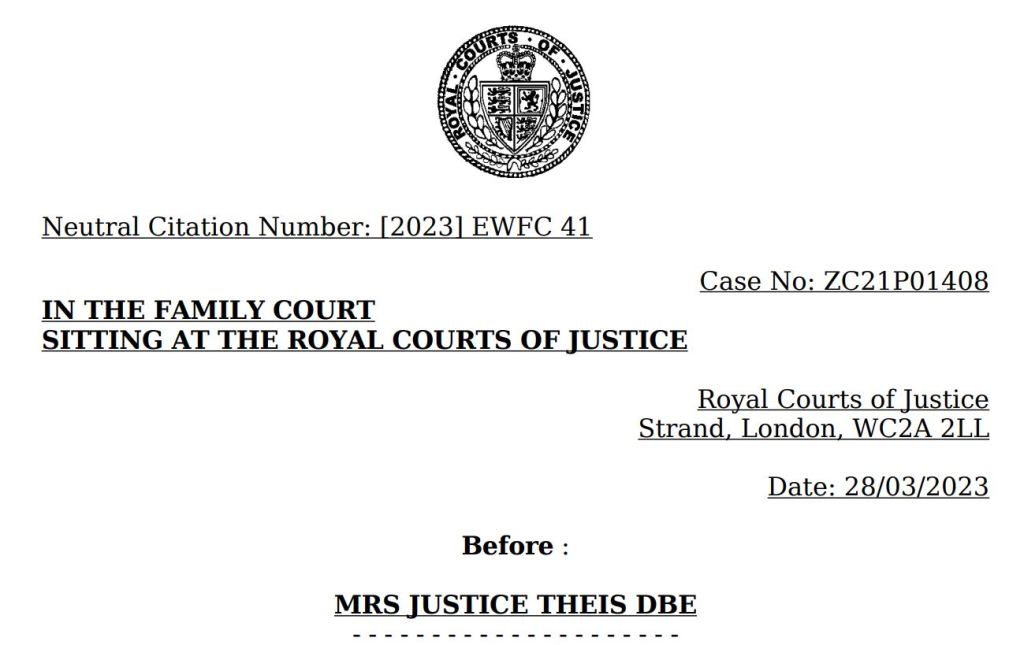
The recent case of X & another v Z & another provides a timely example of how the requirements contained within s54 Human Fertilisation and Embryology Act 2008 may operate in tension with the court’s obligation to have the lifelong welfare of the child as a paramount consideration. The case can be analysed in light of the Law Commissions recommendations for reforming the s54 requirements, as explored in detail in an earlier post.
The background
Heard by Theis J in the Family Division of the High Court, this case concerned primarily the domicile status of the intended parents applying for a parental order. The intended parents, a married couple from the US, entered into a surrogacy arrangement within the UK, with the child being born in 2021. It was acknowledged that most of the s54 criteria had been met. However, the uncertainty relating to the domicile status of the intended parents meant there had to be three separate directions for the applicants to provide evidence, and the case was referred from the magistrates to the High Court.
What is domicile?
S54(4)(b) states that, in order for the court to grant a parental order, either one or both of the applicants must be domiciled in the UK, Channel Islands or Isle of Man. As stated by Theis J in the earlier case of Y v Z, domicile is the ‘jurisdictional gateway to the ability for the court to make a parental order’. Therefore, failure to demonstrate domicile means the court would not be able to grant a parental order, even if it would appear that the welfare of the child necessitated it.
Domicile is a concept centred on where an individual has their permanent home. All individuals will have a domicile of origin, based on where they are born. Alternatively, it is possible for a person to acquire a domicile of choice, which requires the individual to have abandoned their domicile of origin. The burden of proof is on the individual to demonstrate that the UK has become their domicile of choice: this would be shown through the UK becoming their permanent home, along with an intention for indefinite residence.
Demonstrating domicile is, therefore, a question of fact that must be proven on the balance of probabilities.
Demonstrating domicile
As both applicants were from the US, the evidential burden was on them to demonstrate that the UK had become their domicile of choice. The table below captures the key elements that were outlined in the applicant’s evidence and that Theis J referred to when determining whether they had met the threshold for establishing domicile:
| Demonstrating domicile of choice | Factors against domicile of choice |
| There was an intention to live and raise their children in the UK, with plans for further fertility treatment at the same clinic. | The applicants had not yet met citizenship requirements. |
| They intended to obtain a long-term lease or purchase of property in London, and had not retained a residence in the US. | The applicants remained registered to pay tax in US. |
| Their work was transitioning to be based in the UK, including two companies having been established, and one applicant had undertaken education in the UK. | As a result of fieldwork related to studies, the applicants were out of the country for a lengthy period of time, which was ongoing at the time of the hearing. |
| Both applicants had NHS numbers, UK phone numbers and UK bank accounts. | There was a lack of settled accommodation in the UK. |
| The child was born here, and had a UK passport, with no attempt to establish parentage in the US. | There was discrepancy in the applicants’ accounts as to when they moved to the UK and made it their permanent residence. |
| One applicant attended weekly church services and was a member of a local residents’ association. | |
| The applicants had not been to US in two years. |
Much of the evidence provided was statements of future intention as to retaining their residence and life in the UK. Theis J commented that such a ‘self-proclaimed declaration to live here’ had to be considered with caution, unless the actions of the applicants were consistent with that stated intention.
The case was clearly borderline: the evidence provided by the applicants did demonstrate an ongoing intention to settle in the UK and to make their family life there. However, the applicants had been in the UK for a short period of time before applying for the parental order and were not present within the jurisdiction for a period of time due to fieldwork commitments.
The outcome
Notwithstanding the fine balance of factors in this case, Theis J was satisfied that domicile of choice had been established, whilst acknowledging that this determination was ‘largely based on the court accepting the account given by the applicants being credible and truthful’.
In terms of the applicant’s intention to establish the UK as their domicile of choice, reference was made to the consistency in the accounts given by both applicants, which demonstrated a growing wish to reside in the UK. As for the physical act of making the UK their permanent home, various actions were seen to support that intention. For example, choosing to have their baby through surrogacy within the UK, the child having a British passport, not attempting to establish parentage of the child in the US, setting up two companies in the UK and not retaining accommodation in the US.
The outcome in relation to domicile can be seen as marginal in this case. Despite the domicile requirement being a bright line rule within the legislation, there is still a level of judicial flexibility when determining whether the threshold has been met. The impact of not finding the applicants had established a domicile of choice was noted by Theis J when she stated:
This case is particularly difficult as it is hard to ignore the fact that this is an order that all parties agree should be made and is one that is said to meet the welfare needs of this child. It is counter intuitive to do anything other than try and seek that outcome. However, the court has to be careful not to find that the domicile requirement is met unless there is the evidence to support it, however powerful the welfare considerations maybe.
Theis J, para 38.
Will the Law Commissions’ recommendations help in cases such as these?
Domicile
When compared with other s54 requirements, it is clear that the judiciary respect the domicile requirement as being mandatory, potentially because it transcends the issue of the order itself and moves into issue around jurisdiction. Whilst the court can make domicile determinations that are borderline in a way that accords with the welfare of the child, there is a limit to how broadly or purposively this requirement can be interpreted even where it leaves the child’s legal position as precarious.
The difficulty of the domicile requirement was acknowledged in the Law Commissions’ Provisional Proposals and Final Report, particularly – as in this case – when individuals have moved from overseas to live in the UK. However, in the view of the Law Commission, it is important to keep a test of connection to the UK in order to avoid individuals seeing the UK as a surrogacy tourism destination.
The recommendation put forward by the Law Commissions is to retain the domicile requirement, but to add an alternative test of ‘habitual residence’. This test is already established in family law within the UK and Europe, and is perceived to be a simper test to understand. It focuses on where an individual’s centre of interests is, considering relevant factors that link and tie them to the location. Unlike domicile, habitual residence does not need to be for a permanent or indefinite period of time, but it is generally understood to be where you spend most of your time.
For surrogacy arrangements on the new pathway, the domicile or habitual residence requirement would apply to both the intended parents and the surrogate at the time of signing the Regulated Surrogacy Statement and at the time of the child’s birth. In parental order cases, the domicile or habitual residence requirement would apply only to intended parents at the time of applying for, and at the time of granting, the parental order.
When considering the present case, it is not clear to see that the Law Commissions’ recommendation would have made the case any easier to determine. Even adopting the test of habitual residence rather than domicile, the intended parents would still have had to prove that the UK was the centre of their interests, with roots tying them to the location. Such borderline determinations would therefore continue to need to be made.
Payments to surrogates
As a final point, the intended parents had made payments amounting to £15,000 to the surrogate. The issue of payment was dealt with very briefly in the judgment, with Theis J stating:
The surrogacy agreement provided for payments of expenses totalling £15,000. Although there is no expenses list individually itemised, the evidence does not suggest this sum was used other than for expenses reasonably incurred and, if there was any sum left, it was relatively modest and should be authorised in accordance with the principles set out in Re X (A Child) (Surrogacy: Time Limit) [2014] EWHC 3135 [75]. (para 14)
This approach is indicative of how the courts currently deal with the issue of payments. Under s54(8), in order for the court to grant a parental order, it must be satisfied that no more than reasonable expenses have been paid to the surrogate, unless authorised by the court. However, in order to satisfy the best interests of the child and allow a parental order to be granted, sums that do not seem extravagant will inevitably be approved, either as reasonable expenses or otherwise authorised by the court.
The recommendations in the Final Report remove the issue of payments from the allocation of legal parenthood. As such, the amount paid by the intended parents to the surrogate would not affect their recognition as the legal parents of the child. However, there would remain oversight and scrutiny of the payments made, which would have to fall within the defined permitted categories of payments. Under the recommendations, intended parents must declare which category of costs have been paid, along with the amount for each category. Lump sum payments, without a breakdown in what costs have been covered as in this case, would therefore be prohibited under the recommended scheme. What is less clear is how this would be enforced: there is a recommendation to impose civil penalties on intended parents that make payments outside of the permitted framework, but the Law Commissions have left it to the Government to decide whether to proceed with this system.

 reforming surrogacy law
Leave a comment